
Blog · For gyms · retention, data
Gym member retention: the complete 2026 guide
The average gym loses a third of its members every year. A retention guide built on verified research and 2,022 real gym timetables, not recycled tips.
The short version: the average gym keeps 66.4% of its members over a year (HFA 2025), so a third walk out annually. The best-evidenced fix is planning each member's first few weeks: 87% still active at six months versus 60% without it (Dr Paul Bedford). And keeping 5% more members lifts profit 25% to 95% (Bain & Company). Retention is won in week one and defended weekly.
Most retention advice is a list of ten tips that could have been written about any business with a door. This guide sticks to two things: numbers that can actually be checked, and what 2,022 real gym timetables told us about where the risk hides. Every figure has a name and a date on it.
What normal gym retention looks like, so you know if you have a problem
The Health and Fitness Association's 2025 benchmarking report, built from 175 companies running more than 17,000 facilities across 27 countries, put average annual member retention at 66.4%. Read that as an operating condition: the typical gym must replace one member in three every year before it grows by a single person. At 250 members and a £75 monthly fee, that missing third is roughly £75,000 of yearly revenue walking out the door and being expensively replaced.
The same maths is why retention beats marketing as a place to spend effort. Bain & Company's research, led by Frederick Reichheld, found that keeping just 5% more of your customers raises profit by between 25% and 95%, because a kept member keeps paying while costing almost nothing more to serve. That work spans many industries rather than gyms alone, but a membership business is precisely the shape it describes.
Members are won or lost in their first few weeks
The strongest single finding in gym retention research concerns the start. Dr Paul Bedford, whose career is built on member data, found that 87% of members whose gym planned their first few weeks were still active at six months, against roughly 60% of those left to find their own feet. Nothing later in the relationship, no offer, no discount, no loyalty scheme, moves the number by 27 points.
What a planned start means in practice is small: a named class where new starters belong, a training partner from the first session, the second visit booked before the first one ends, and someone who notices the first missed week. We covered what happens without this, and how rarely gyms provide it, in why white belts quit; the short version is that most quitting decisions form in the first six to eight weeks, before training has become a habit.
A member's training week is narrower than it looks
Here is the part no benchmark report will tell you, because it comes from our own data. Mat Track runs a directory of more than 11,000 martial arts gyms, and in August 2026 we analysed the 2,022 public timetables in it: 35,970 scheduled classes.
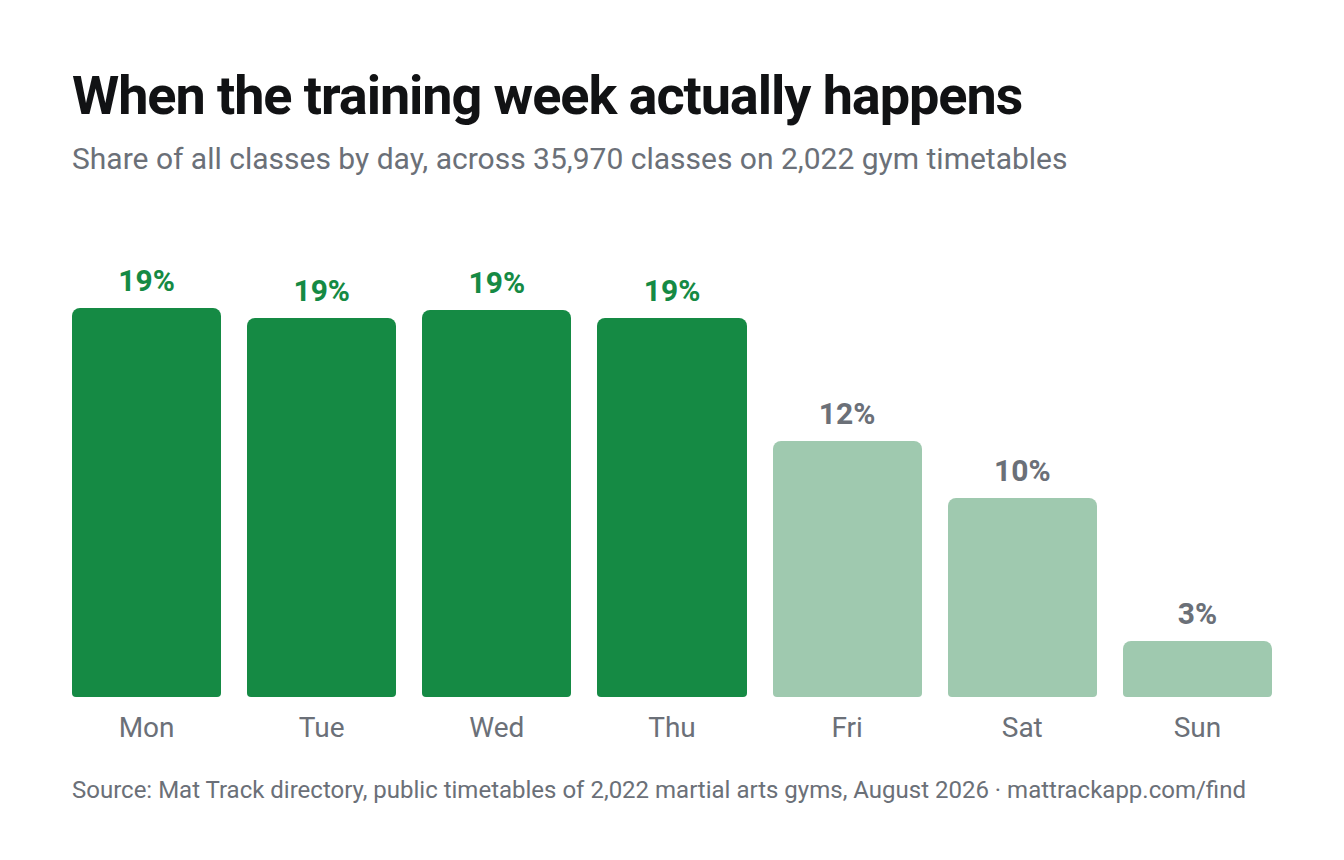
The median gym runs 15 classes a week (a quarter run 8 or fewer, a quarter 24 or more). More than half of all classes, 56%, sit between 5pm and 9pm, and the 6pm hour alone holds 21% of everything scheduled anywhere. Monday to Thursday carry 19% of classes each; Friday falls to 12%, Saturday 10%, and Sunday is nearly dark at 3%.
For retention, that shape matters more than it looks. A typical member's entire relationship with your gym is two or three fixed evening slots inside a four-hour window on four days. When their life changes shape, a new job with later hours, a school run, a partner's shift pattern, both of their slots usually break at once, and your timetable often has nowhere for them to land. That is why attendance falls off a cliff rather than fading politely, and why the fix is noticing the first broken week and pointing at the alternative slot before the habit dissolves. The benchmarks are worth knowing too: 72% of gyms in our data run kids classes, 31% run an open mat, and only 37% run a named beginners class, which is the cheapest retention fix on this page.
The five things that actually move retention
Plan the first few weeks. The Bedford numbers above are the whole argument. A named beginners class, a training partner, the next session booked, a message on the first quiet week. It costs organisation, not money.
Watch each member against their own normal. A rule like "flag anyone under twice a week" misses the three-times-a-week member who quietly drops to once. The signal is change against that member's own pattern, and it appears weeks before the cancellation email. By the time "life got busy" arrives in writing, the decision is old.
Make progress visible. In belt sports the next rank can be a year away, which is a long time to persist on faith. Stripes and gradings with criteria said out loud, attendance milestones, anything the member can see moving keeps the long gaps survivable.
Build friendships, not just classes. A member with a regular training partner and a coach who greets them by name has reasons to return that have nothing to do with motivation. A member who knows nobody can vanish and feel that nobody noticed. It is also worth knowing which coaches keep their members: the class-level numbers usually surprise owners.
Invite lapsed members back properly. A personal message at 30, 60 and 90 days after someone goes quiet, with a concrete way back in, costs minutes and recovers a real share of leavers. It works because the member usually did not decide against you; their routine broke and nobody offered a way back.
The weekly rhythm that makes retention stick
Retention fails as a document and works as a routine. Weekly, fifteen minutes: who has dropped below their own normal, and who messages them. Monthly: members lost, churn rate, the stated reason for each leaver, and how the newest joiners are attending compared with their first month. Quarterly: retention by class and by coach, pick the worst number, change one thing, and check it next quarter. A coach with a spreadsheet can run all of it; the hard part is doing it every week while also running a gym.
Where retention software fits, honestly
Mat Track is our product, built inside a working jiu-jitsu academy where this routine runs every week, so read what follows with that in mind. The console watches each member's attendance against their own 60-day pattern and flags the drops, which is the weekly review done for you. Comeback challenges, off by default until you have a month of data, handle the 30-day invitation back. On the member's side, the app makes progress visible between gradings, streaks, milestones, and the community features that turn classmates into the friendships that keep people. Plans start at $49 a month after a 7-day free trial, with attendance alerts on Growth and Pro, as of October 2026 (pricing here).
The industry average says you will lose a third of your members this year. The research says most of that is decided in the first few weeks and signalled weeks before it lands. The timetable data says your members' habits are narrower and more breakable than they look. All three point at the same job: plan the start, watch the pattern, and act on the first quiet week.