
Blog · For gyms · comparisons
Best TeamUp alternatives for martial arts gyms (2026)
TeamUp is fair, well-liked software with no grading system. Six alternatives for the schools that discover that on grading day, with verified pricing.
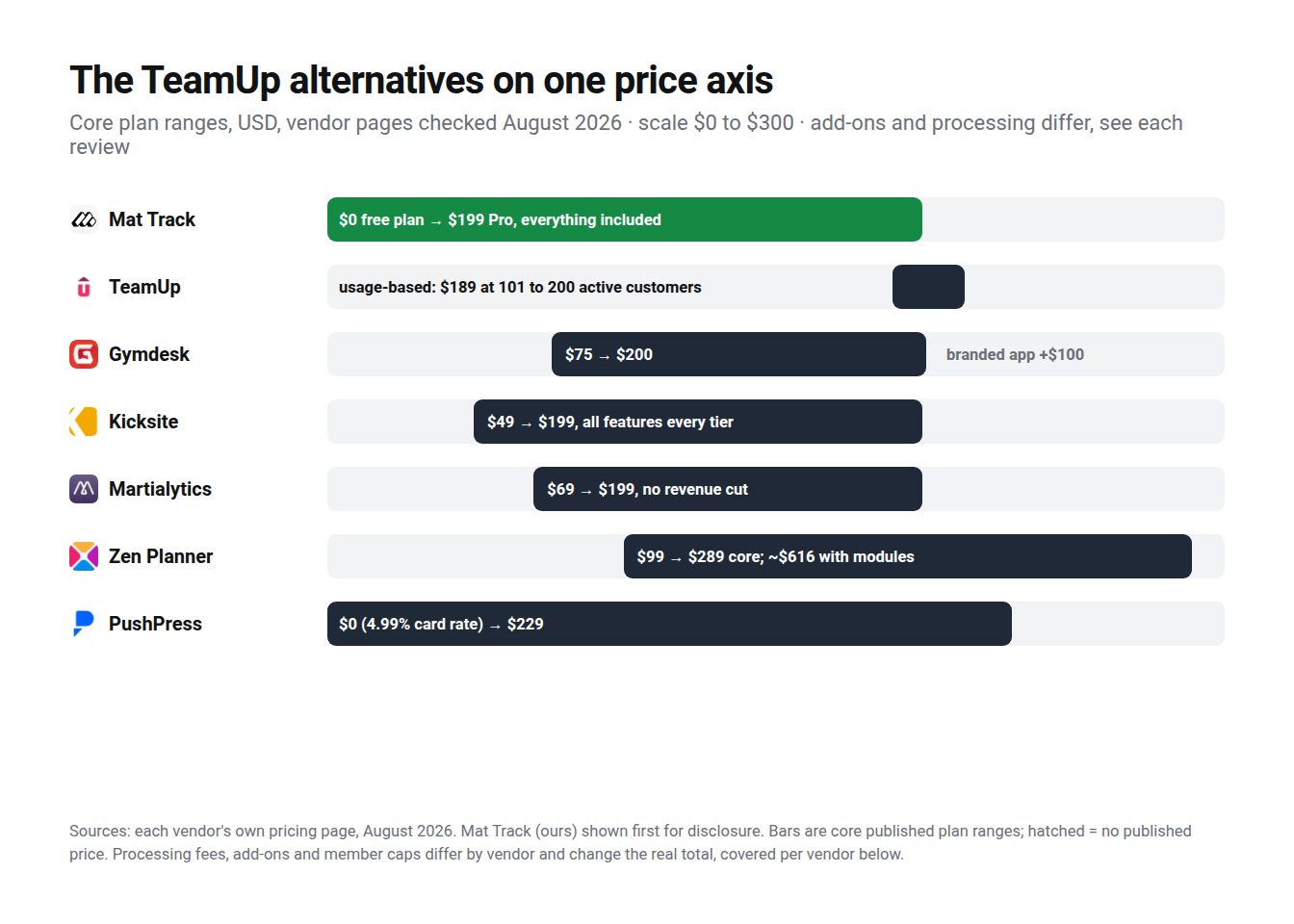
The short version: the TeamUp problem arrives on grading day, when a fair, well-liked booking platform, 4.8 on Capterra, the market's fairest billing, meets a stack of belt records it has no fields for. TeamUp has no concept of ranks, gradings or curricula, as of August 2026, and the tag-based workarounds age badly. Six alternatives below, priced from the vendors' own pages, for schools whose spreadsheet just failed a black-belt test.
TeamUp's grading-day gap
Be clear about what TeamUp gets right, because it is a lot. Usage-based pricing where only customers who actually show up in a month count, $189 at the 101 to 200 tier; no setup fee, no contract; a member app in the base price; and a 4.8 Capterra rating across roughly 350 reviews built on ease of use and responsive support. Its reviewers' one recurring money gripe is drift, costs described as rising, one citing a 20% jump after a year, but even that sits inside a no-contract deal you can leave any month.
What it does not have is the mat. Belts, ranks, gradings and curricula appear nowhere in the advertised product; schools run them through tags, custom fields and spreadsheets. That holds at 60 students in one art. It breaks quietly as the roll grows, and loudly the first time a grading requires cross-referencing three systems to know who is eligible. In our 5,191-site crawl only 0.7% of software-running martial arts gyms use TeamUp, and the gap is why.
Mat Track, ranks plus the retention layer
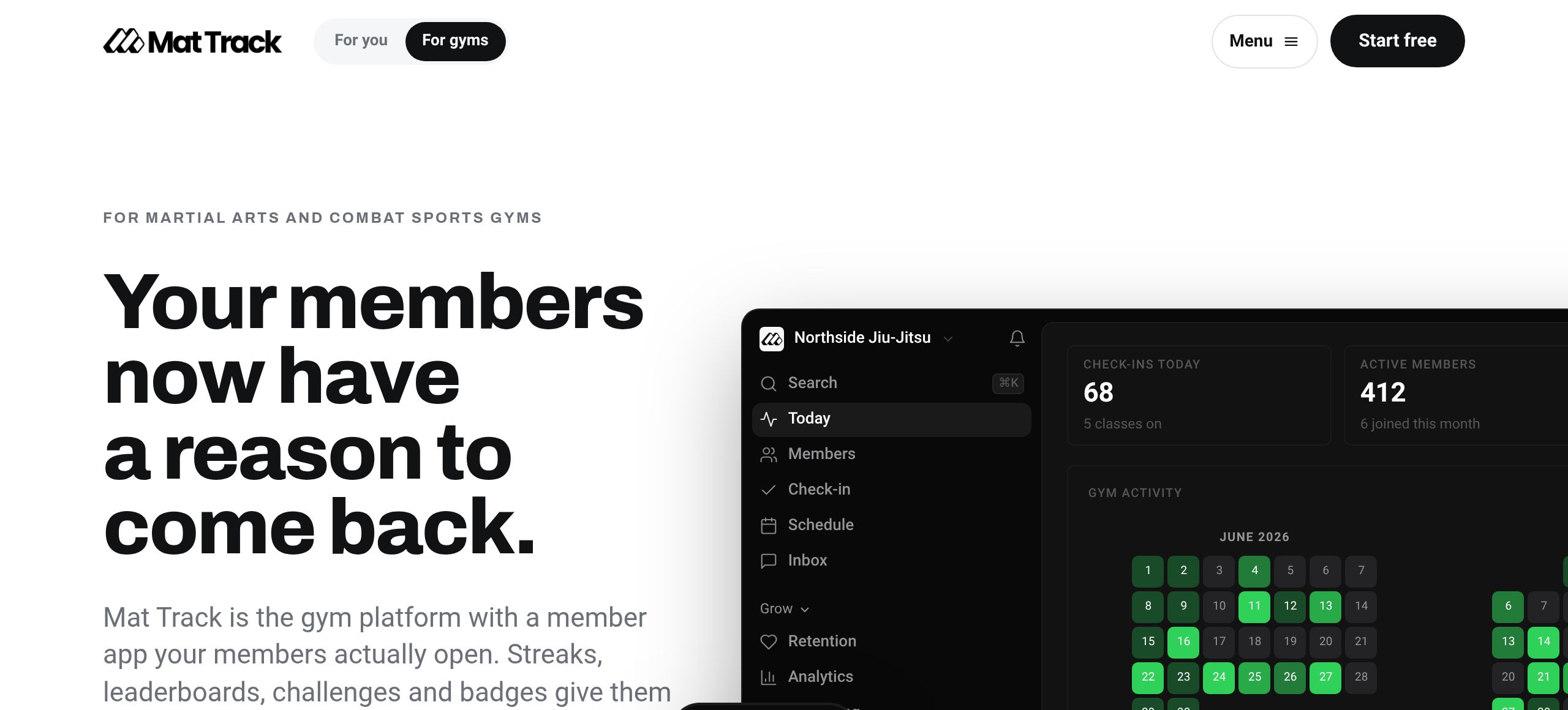
Ours, so discount for bias. Mat Track keeps two TeamUp virtues, published pricing and no platform cut on payments, and adds the entire missing layer: multi-art rank ladders with grading criteria members read in the app, criteria-based grading events, and retention alerts that watch each member against their own 60-day attendance pattern. The member app is built for daily habit, streaks, badges, leaderboards, community, and ships in every plan; a 7-day free trial, then $49 Starter, $99 Growth, $199 Pro, as of October 2026.
Mat Track's AI front desk, Marty, is now in early access: see how the alternatives compare on AI.
Where it wins:
- Gradings are built in properly, not improvised with tags.
- Alerts you when a member starts fading, which TeamUp never attempts.
- The member app is included, where TeamUp charges $99 a month for its branded one.
Where it falls short:
- TeamUp's usage-based billing is fairer for seasonal rolls.
- No course-style scheduling for studios that run programmes alongside classes.
The side-by-side is on our TeamUp switching page.
Kicksite, the grading specialist
The strongest answer to the specific failure: custom belt curricula, testing events, one-click promotion of eligible students, full histories, $49 to $199 with every feature at every tier, 4.8 on Capterra. Students use a mobile web portal rather than an app, and automation watches invoices, not attendance.
Where it wins:
- The best belt-testing and grading administration in the market.
- Flat, published pricing with nothing gated by tier.
- A long, trusted history with traditional schools.
Where it falls short:
- Students get a website to log into, not a real app on their phone.
- Nothing watches attendance for you; spotting a fading member is still your job.
- The feature set thins out once you step outside belt administration.
Full treatment in our Kicksite alternatives guide.
Martialytics, TeamUp's temperament with martial arts bones
The closest match for TeamUp's likeable fairness: martial arts only, $69 to $199 with everything included, unlimited locations, free student app, standard Stripe rates with no revenue cut, free leads and inactive students. Belts and gradings are native. It is a small operation with a lighter feature set and no retention automation.
Where it wins:
- Simple, fair pricing in the same spirit as TeamUp.
- Belt and grading tracking is built in.
- Unlimited locations at every tier.
Where it falls short:
- Nothing watches attendance for you; spotting a fading member is still your job.
- Its app shows schedules and updates; it is not built to pull students back in daily.
- A small company with a small footprint, under 1% of the installs in our crawl.
More on our Martialytics switching page.
Gymdesk, the volume incumbent
The most-installed platform in our crawl: $75 to $200 by member count, all features every tier, website builder included, month to month, 4.8 on Capterra across about 150 reviews. Ranks exist but stay basic, and the branded app is $100 a month.

Where it wins:
- Simplicity, a website in the bundle, and the largest martial arts install base.
Where it falls short:
- Belt tracking is basic, barely better than the tag workaround you are leaving.
- The branded member app costs an extra $100 a month.
- You get reports to check, not alerts that tell you when a member is drifting.
Subject of our Gymdesk alternatives guide.
Zen Planner, full depth at module prices
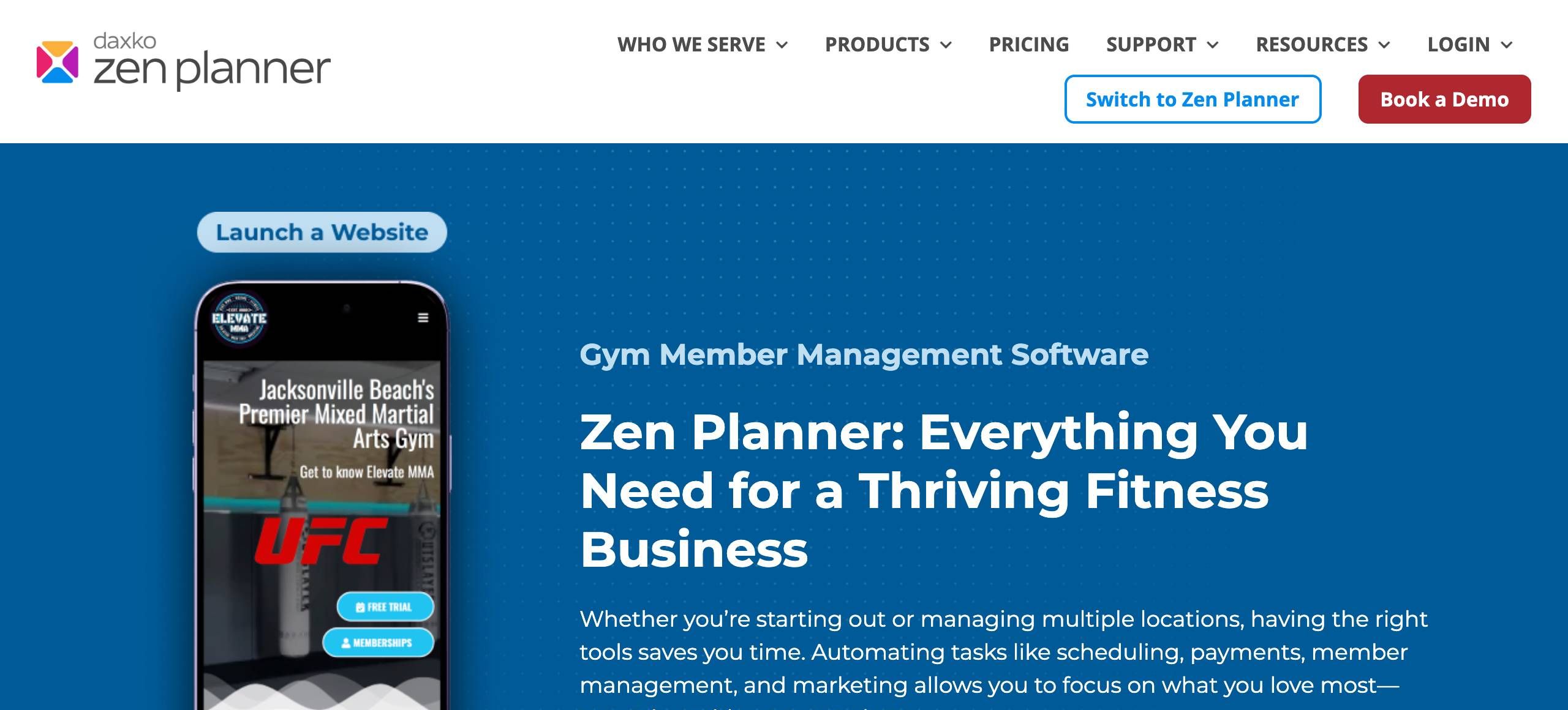
The veteran: native belt testing refined over two decades, a website product, and a modular bill, $99 to $289 core plus app ($39), website ($99) and Engage ($249), about $616 configured at 150 members, Capterra 4.3 across 270 reviews with billing friction the recurring complaint. Coming from TeamUp's clean billing, read our Zen Planner pricing breakdown first.
Where it wins:
- Grading depth to match Kicksite plus modules TeamUp never had.
Where it falls short:
- The module bill reaches about $616 a month configured, a shock after TeamUp's fair usage-based billing.
- The price jumps steeply each time your member count crosses a tier.
- Its reviewers' cancellation complaints.
PushPress, published everything
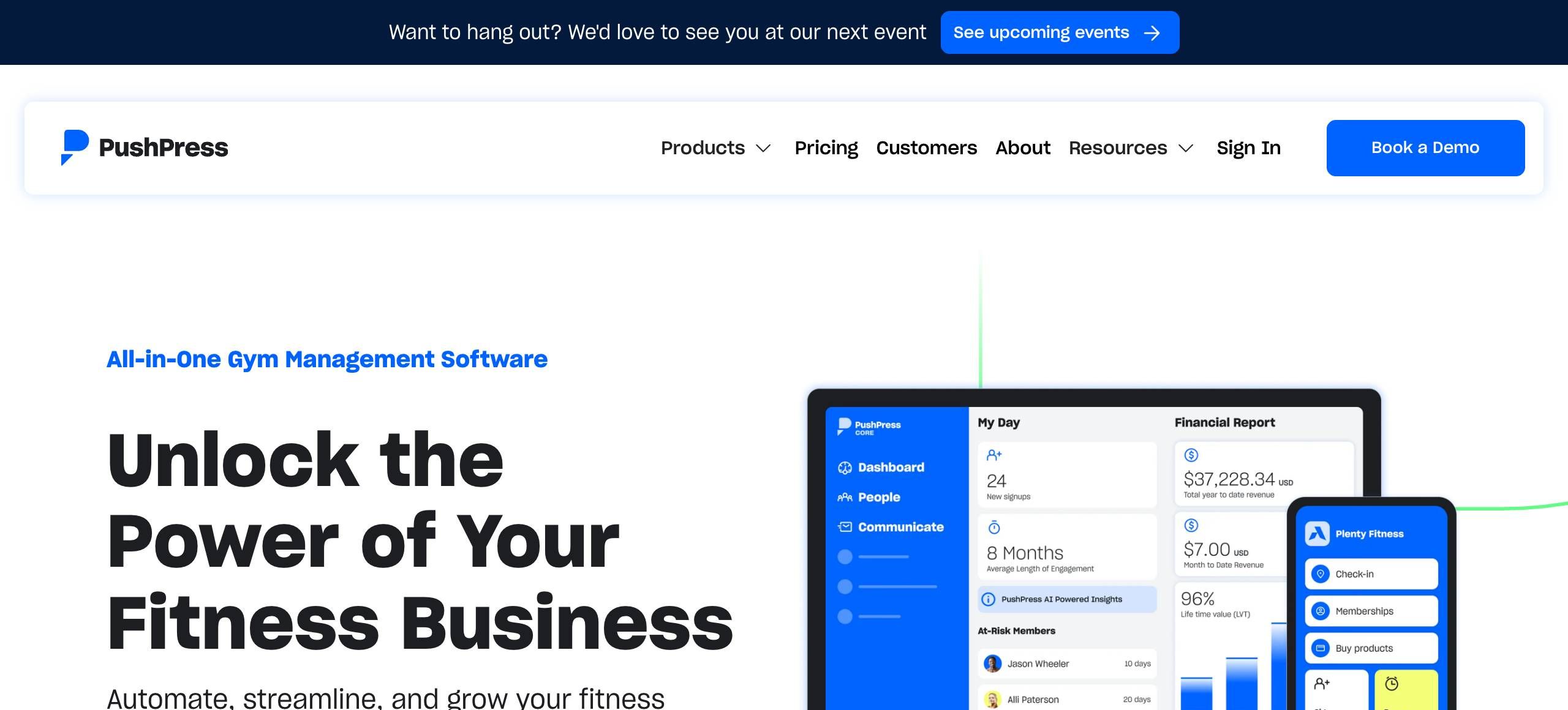
If TeamUp's transparency is what you want to keep, PushPress matches it: $0, $159, $229 with card rates published (4.99% on Free, 2.89% on Pro, 2.75% on Max), 4.7 on Capterra. Rank tracking sits in the paid tiers, and free-plan economics flip near $7,600 a month in card volume, per our PushPress pricing breakdown.
Where it wins:
- Transparency equal to TeamUp's.
- A real free tier.
- Modern polish.
Where it falls short:
- Belt and rank tracking needs the $159 Pro tier.
- The free plan's 4.99% card rate gets expensive once you take real money by card.
- Built for functional fitness first; martial arts is a side room, not the main hall.
TeamUp alternatives with AI for the front desk
Two of the five other alternatives sell AI, as of 19 October 2026: Zen Planner and PushPress. Kicksite, Martialytics and Gymdesk market none. TeamUp's AI Receptionist and Zen Planner's Engage AI answer messages on their own; PushPress's AI Assistant asks first but cannot message members. None says its AI can refund a member. Mat Track's Marty, in early access, drafts member replies and sets up Stripe refunds, with your team approving each one.
| Software | Its AI, 19 Oct 2026 | Who has the final say |
|---|---|---|
| Mat Track | Marty (early access): drafts member email and text replies, sets up Stripe refunds and cancellations, answers staff questions from your records | Your team, before anything is sent or refunded |
| TeamUp | AI Receptionist for web chat and social DMs (Marketing Suite, $109 a month); monthly AI Business Advisor report | The AI |
| Kicksite | None advertised | No AI |
| Martialytics | None advertised | No AI |
| Gymdesk | None advertised | No AI |
| Zen Planner | Engage AI (separate product, from $249 a month): answers calls, texts, web chat and DMs; books trials | The AI |
| PushPress | AI Assistant (Pro, Max): answers questions, pauses or cancels plans, applies charges; no refunds listed. Conversation AI for texts, DMs and web chat (Grow add-on, $329 a month plus message fees) | Assistant: you, it asks first. Conversation AI: you or the AI, your setting |
Sources: each vendor's own website or help centre, checked 19 October 2026: TeamUp Marketing Suite, AI Advisor; Kicksite; Martialytics; Gymdesk; Zen Planner Engage AI, pricing; PushPress AI Assistant, pricing, Grow.
Marty is Mat Track's AI front desk, in early access. Ask him who has gone quiet this month, how many trials joined or whose payment failed, and he answers from your own records with the source beside each answer; owners can also ask about revenue by club and who left and why. Between classes you can ask out loud from his phone app, and he answers in text. Meet Marty or start free and request him.
TeamUp's AI Receptionist answers web chat and social DMs automatically, in a Marketing Suite add-on at $109 a month, and lists no billing actions. Marty does the reading, checking and drafting, the part that eats front-desk hours, and your team makes the call. Every step he takes is logged.
How to choose software after TeamUp
Write down what grading day actually requires at your school, eligibility rules, testing events, per-art ladders, promotion records, and strike any candidate that handles them with tags. Then keep TeamUp's own standard: published pricing you can compute from the vendor's page, and no contract terms you would not sign twice. Mat Track and Kicksite bracket the specialist end, retention-first and testing-first respectively, with the retention mechanics laid out in our gym member retention guide. Mat Track's prices are one page at mattrackapp.com/gyms whenever you want the disclosed baseline.