
Blog · For gyms · retention, data
Why white belts quit BJJ, according to 1,010 timetables
The 90% dropout figure is folklore. We analysed 1,010 BJJ gym schedules and the retention research to find what actually makes white belts stay.
The short version: the claim that 90% of white belts quit before blue belt is folklore; no study exists. What is measurable: gyms that plan a new member's first few weeks keep 87% at six months against 60% for those that don't (Dr Paul Bedford), and of 1,010 BJJ timetables we analysed in August 2026, 53% have no named beginner class at all. Most quitting happens in the first six to eight weeks.
Every BJJ coach has heard the 90% number. It gets repeated in podcasts, forum threads and gym chats as if someone, somewhere, counted. Nobody did. This post replaces the folklore with three things: the retention research that actually exists (including the HFA's 66.4% industry-wide annual retention benchmark), what 1,010 real gym timetables reveal about the classes beginners actually get, and a first-90-days system a gym can run without buying anything.
The 90% dropout figure is folklore, but the real numbers are bad enough
There is no published study tracking white belts to blue belt across gyms. What exists is broader fitness-industry research, and it is sobering without exaggeration. The Health and Fitness Association's 2025 benchmarking report, covering 175 companies and more than 17,000 facilities across 27 countries, put average annual member retention at 66.4%. A third of members gone every year is the industry baseline, and combat sports gyms have a harder version of the problem: the product involves being physically beaten by strangers for months before it feels like winning.
The one thing with strong evidence behind it is how a gym handles a member's first few weeks (the research calls it structured onboarding). Dr Paul Bedford, whose research career is built on gym retention data, found that 87% of members whose first weeks were planned were still active at six months, against roughly 60% of those left to find their own feet. A 27-point swing, from the first eight weeks alone. Nothing a gym does later, no comeback offer, no loyalty scheme, moves the number that much.
What 1,010 BJJ timetables told us
Mat Track runs a directory of more than 11,000 martial arts gyms, and for a large share of them we hold the public class schedule as published on the gym's own website. In August 2026 we analysed the timetables of 1,010 BJJ gyms. Three findings stood out.
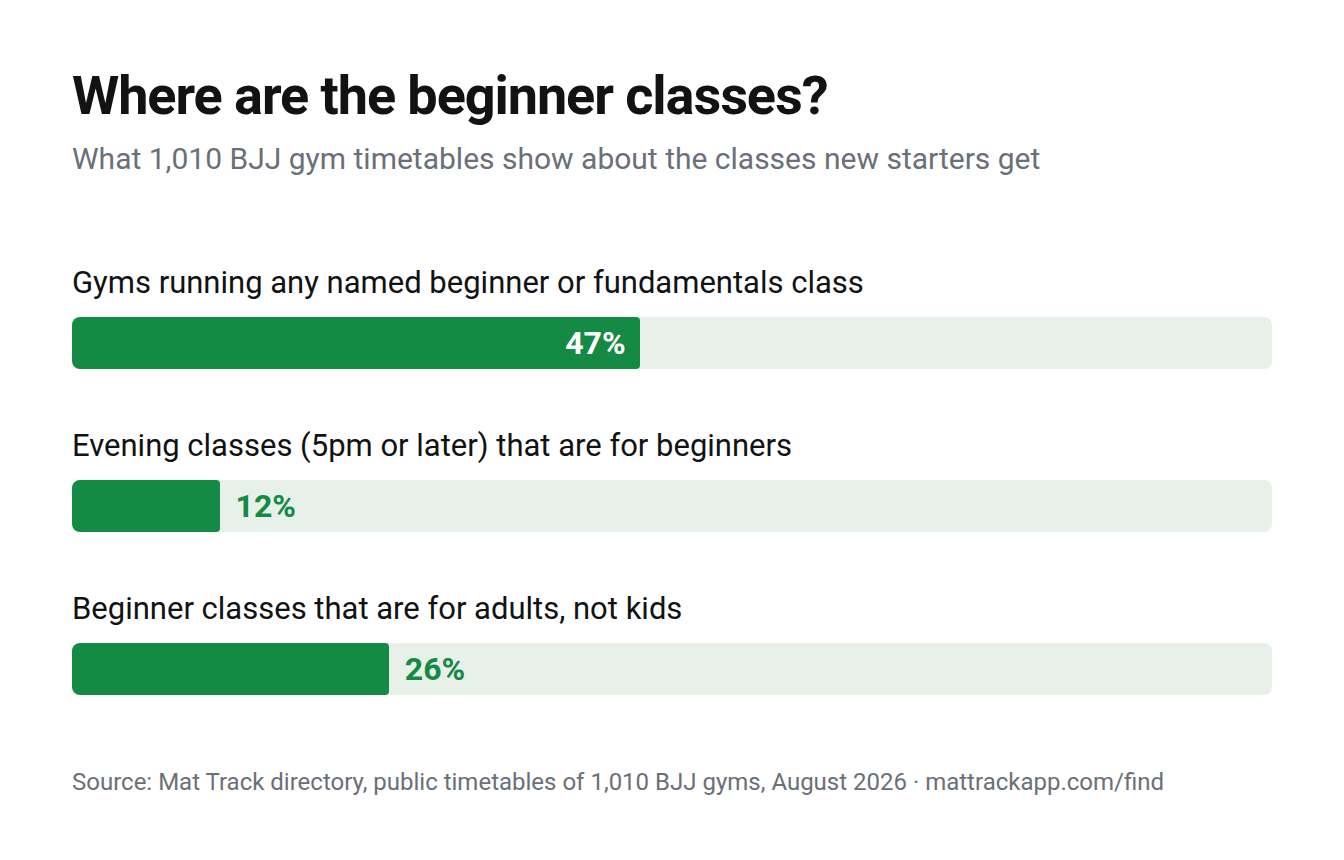
53% of BJJ gyms run no named beginner class at all. No Fundamentals, no Beginners, no Intro, nothing on the public timetable that tells a nervous first-timer where to stand. The 47% that do run one average 4.2 beginner classes a week, so the gyms that run one take it seriously rather than treating it as a token slot.
Peak hours belong to everyone except beginners. Across evening classes starting at 5pm or later, the hours a working adult can actually attend, only 12% are beginner-labelled. A white belt with a day job usually walks into an all-levels room on night one. All-levels classes can be taught brilliantly, but the label tells a beginner nothing about whether they belong there, and the first weeks are exactly when that doubt decides things.
Kids get proper beginner classes. Adults mostly don't. Across the 2,022 combat-sports schedules in the wider dataset, gyms run 9,530 kids classes against 3,427 adult beginner classes, nearly three to one. Gyms long ago worked out that children need classes built for their level. The same thinking mostly hasn't reached the adult white belt, who is arguably more likely to quit and definitely paying more.
One honest caveat: a timetable shows labels, not teaching. A gym with no Fundamentals class may still look after beginners superbly inside all-levels sessions. But labels are what a prospective member sees before they ever meet the coach, and at the scale of a thousand gyms, the pattern says the industry plans its week around the people who already stayed.
Why white belts actually leave
The reasons white belts give, and the reasons underneath them, are more specific than "it's hard".
Losing without a frame. A white belt loses nearly every round for months. Experienced grapplers know this is the curriculum; beginners experience it as evidence they're not suited to it. The gyms that keep people are the ones that say so out loud, in week one, before the first bad night.
Progress they cannot see. Blue belt is typically one to two years away. Without stripes awarded against explicit criteria, or some other visible marker, the first year is a plateau by design. People do not persist for a year on faith.
The habit never forms. Attendance in the first six to eight weeks predicts everything. A beginner who trains twice a week from the start has a habit by month two; one who comes sporadically is quietly deciding to leave, whatever they say at the desk.
Nobody would notice. A member with a regular training partner, a coach who knows their name and someone who asks where they were on Tuesday has three reasons to come back. A member who knows nobody can vanish without a single person registering it, and they can feel that in advance.
Fear of getting hurt. Actual injuries end some memberships, but perceived danger ends more. A beginner class with controlled rounds and explicit safety framing removes most of that perception. An all-levels room at 7pm does the opposite.
"Life got busy." The reason on the cancellation form, and almost never the cause. Life was always busy. Training slid down the priority list because the value eroded first, through some mix of everything above. It is the last sign, not the first: by the time you read it, the decision was weeks old.
A white belt's first 90 days, as a system
None of this needs software, it needs the decisions made in advance. Give beginners their own class, called Fundamentals or Beginners, with at least one in an evening slot, so the timetable itself tells a new starter where they belong. Give every starter a named training partner in their first session; one friendship is often the difference between coming back and not. Book session two before session one ends, because "see you Thursday" keeps far more people than "see you soon". For the first eight weeks, watch each beginner's attendance against their own normal, and the first week they go quiet, message them personally, not with a mailshot. And put visible progress inside the first 90 days: stripes at defined milestones, with the criteria said out loud when they're awarded.
A coach with a spreadsheet can run all of it. The hard part is noticing the quiet week reliably, every week, for every beginner, while also running a gym.
Where gym software fits, honestly
That noticing job is what retention software is actually for. Mat Track is our product, built inside a working jiu-jitsu academy where we run this system ourselves, so read the next sentences with that in mind. The console tracks each member's attendance against their own 60-day baseline and flags the ones who drop below it, which is the "first quiet week" signal from the system above, automated. Comeback challenges, off by default until you have a month of data, invite a lapsing member back with a target rather than a guilt trip. On the member's side, the app gives white belts the visible progress the belt system withholds: streaks, milestone badges and the community features that turn training into friendships, which is what actually keeps people. Plans start at $49 a month after a 7-day free trial, with attendance alerts on Growth and Pro, as of October 2026 (pricing here). And if you run a gym, your page is probably already on the directory, whether or not you've claimed it.
The folklore says white belts quit because jiu-jitsu is hard. The data says they quit in a predictable window, for addressable reasons, and that half the industry's timetables aren't addressing them. That is bad news for the average gym and an opening for yours.