
Blog · For you · getting started, choosing a gym
How many classes a week does a martial arts gym run?
We counted 35,970 classes across 2,022 published gym timetables. The median gym runs 7 to 22 a week, and only 12% of them are at the weekend.
The short version: the median martial arts gym runs between 7 and 22 classes a week depending on the art, and only 12% of those classes are at the weekend. We counted 35,970 classes across 2,022 published timetables in September 2026. MMA gyms run the most at a median of 22 a week, jiu-jitsu gyms 18, and aikido dojos the fewest at 7.
Most people taking up a martial art assume they will train at the weekend. It is the obvious time: no work, nothing to rush back from. Of the 35,970 classes we counted, 12% fall on a Saturday or Sunday. That one number quietly reshapes what training is going to look like for you, and it is the kind of thing most people only discover after they have signed up.
What the timetables show
These are median weekly class counts, taken from gyms that publish a full schedule. The sample size for each art is in the last column, because a median from 27 gyms deserves less trust than one from 1,010.
| Art | Median classes a week | Gyms counted |
|---|---|---|
| MMA | 22 | 132 |
| Jiu-jitsu | 18 | 1,010 |
| Muay thai | 15 | 43 |
| Kickboxing | 15 | 27 |
| Kung fu | 12 | 24 |
| Boxing | 11 | 51 |
| Taekwondo | 10 | 42 |
| Fencing | 10 | 17 |
| Judo | 9 | 115 |
| Karate | 9 | 93 |
| Aikido | 7 | 44 |
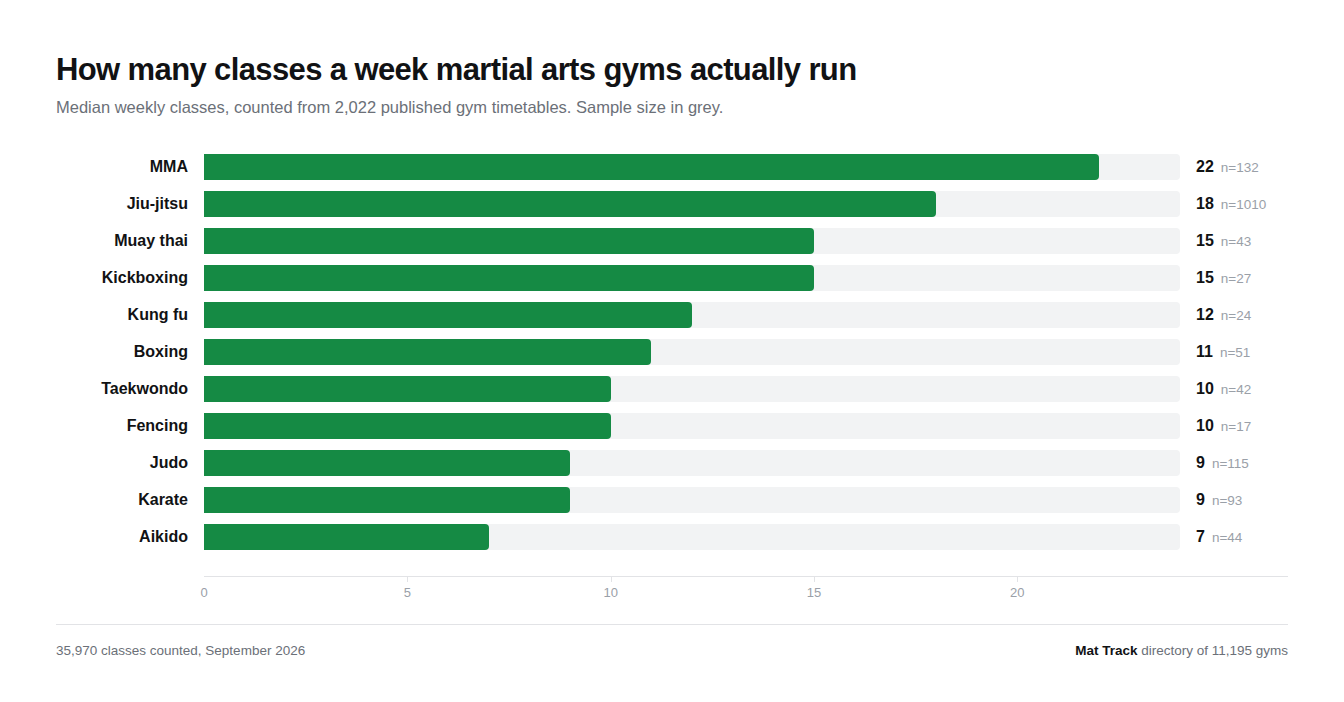
The gap between the top and the bottom of that table is the thing worth noticing. An MMA gym runs roughly three times as many sessions as an aikido dojo. That is not a judgement about either art. It reflects how they are organised: MMA and jiu-jitsu grew up around full-time commercial gyms with paid coaching staff, while judo, karate and aikido are still largely taught at clubs, often in shared halls, often by volunteers, on the two or three evenings a week the hall is free.
If you are choosing between arts and you want to train often, that difference matters more than anything you will read about which style is more effective.
When classes actually run
Counting classes only tells you half of it. The other half is when they are, and here the pattern is consistent enough to plan around.
Of the 35,970 classes we counted, 56% start after 5pm. Another 25% start in the morning, before noon. The remaining fifth are spread across the middle of the day, which in practice means daytime classes at the small number of gyms with full-time coaches.
The number that catches most people out is the weekend. Only 12% of all classes fall on a Saturday or Sunday. Plenty of gyms run nothing at all at the weekend, and where they do it is often one open mat rather than a taught class.
That single figure quietly undermines a lot of standard advice. "Train three times a week" is easy to say. If you work weekdays and finish at six, and your nearest gym runs its adult classes at 6pm with nothing on Saturday, then three times a week is not a question of discipline. It is a question of arithmetic.
What this means when you are choosing a gym
The useful move is to stop reading the timetable as a measure of how good a gym is, and start reading it as a measure of how well it fits your week.
Take the timetable and cross off every class you could not physically attend: the ones that clash with work, the ones that are kids only, the ones on the far side of town on a night you cannot travel. What is left is your real number. A gym advertising 30 classes a week where four of them work for you is worse for you than a club running eight where five of them do. Our guide to how many times a week a beginner should train covers what to do with that number once you have it.
This is also worth checking before you commit to anything longer than a month. The most common reason people stop training is not that they lost interest, it is that the training stopped fitting their life. We wrote about that pattern in why white belts quit, and the shape of it is the same across every art we looked at.
If you want to compare timetables near you, our gym directory lists 11,195 gyms worldwide, and for the 2,022 that publish one, the weekly schedule is on the gym's page.
How we counted
The numbers come from the timetables published by gyms in the Mat Track directory, read in September 2026. A class is one recurring weekly session with a day and a start time, so a gym running a 6pm and a 7pm session on a Tuesday counts as two.
Three things to be honest about. First, this only includes gyms that publish a timetable at all, which is 2,022 of the 11,195 in the directory, and gyms that publish one are probably a little more organised than average. Second, some of the counts include kids' classes, which inflates the total for arts with large children's programmes such as taekwondo and karate. Third, the small samples deserve caution: the fencing and kung fu figures rest on fewer than 25 gyms each and could move with a larger sample.
We will re-run this as the directory grows. If your gym publishes a timetable and it is not on your page yet, you can claim the page and add it.
Once you are training, the thing that actually helps is keeping a record of what you did, which is why we built the Mat Track app around one-tap session logging. If you are curious what that looks like alongside other people at your gym, the community features are the other half of it.