
Blog · For gyms · software, data
Best muay thai gym software in 2026, 7 compared
Muay thai gym software compared: seven platforms on vendor-published prices, the evening check-in rush, the member app, and which suits your gym.
The short version: for a muay thai gym in 2026, Mat Track (from $49 after a 7-day free trial, built for combat sports, ours) and Gymdesk ($75 up, the most-used platform in our crawl of 5,191 gym websites) are the two to shortlist, with Kicksite from $49 for traditional clubs and PushPress free-to-start for hybrid gyms. 78% of gym websites we crawled run no booking software at all, so doing nothing is the real market leader.
Every list like this is written by a software company, including this one; Mat Track is our product and it is in the list. What the others cannot offer is data: we run a directory of more than 11,000 martial arts gyms and crawled 5,191 of their websites in August 2026 to see what software gyms actually use, rather than what gets reviewed. Prices below are from vendor pricing pages, checked August 2026.
What a muay thai gym's week asks of its software
In our directory's timetable data, 272 gyms schedule 1,697 muay thai classes a week, about 6 per gym, and 59% of them start at 5pm or later. That concentration is the whole software problem in one line: nearly everything happens in a two-to-three-hour evening burst of check-ins, walk-in trials and payments, run by coaches who are about to teach. Software that adds clicks to that window gets abandoned; software that removes them earns its fee. The other constant is the membership model: muay thai gyms mostly sell monthly memberships with gradings and the occasional fight-team squad, not the drop-in class packs studio software is designed around.
The software gyms actually run, measured
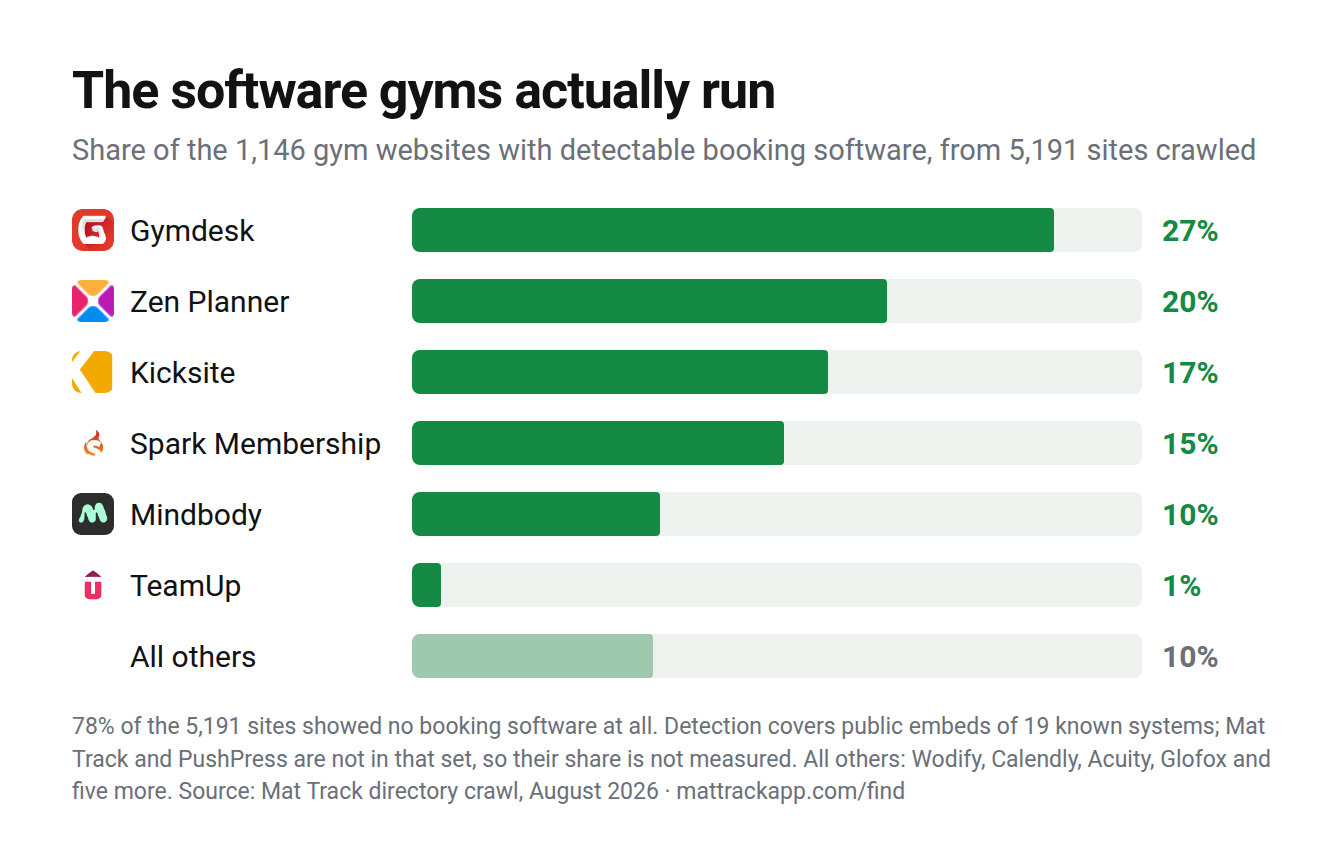
How this chart lines up with the seven reviews below, and where it honestly cannot. Detection covers public embeds for 19 known systems, so software used purely at the front desk is invisible to us, and two of the platforms reviewed below are not in the detection set at all: Mat Track (our own) and PushPress, so the chart says nothing about their share either way. TeamUp is detected and barely registers among martial arts gyms at 1%, which fits its studio focus. Spark Membership earns a real bar at 15% but is not one of the seven reviewed here; it is martial-arts-focused and belongs in a future post. The headline stands regardless: nearly four in five gym websites show no booking system at all, and among those that do, the specialists collectively outweigh the big-name studio platforms.
The seven, compared on verified pricing
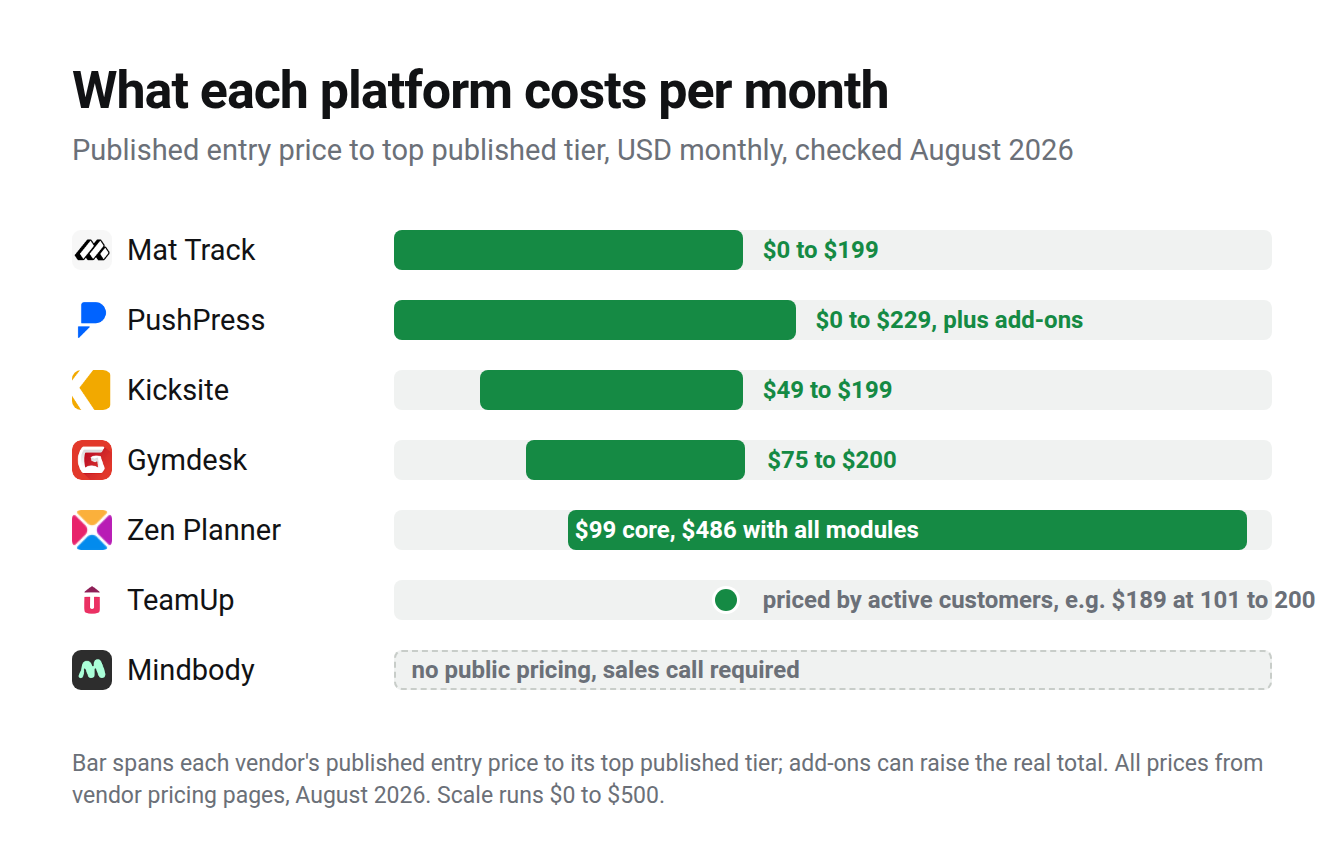
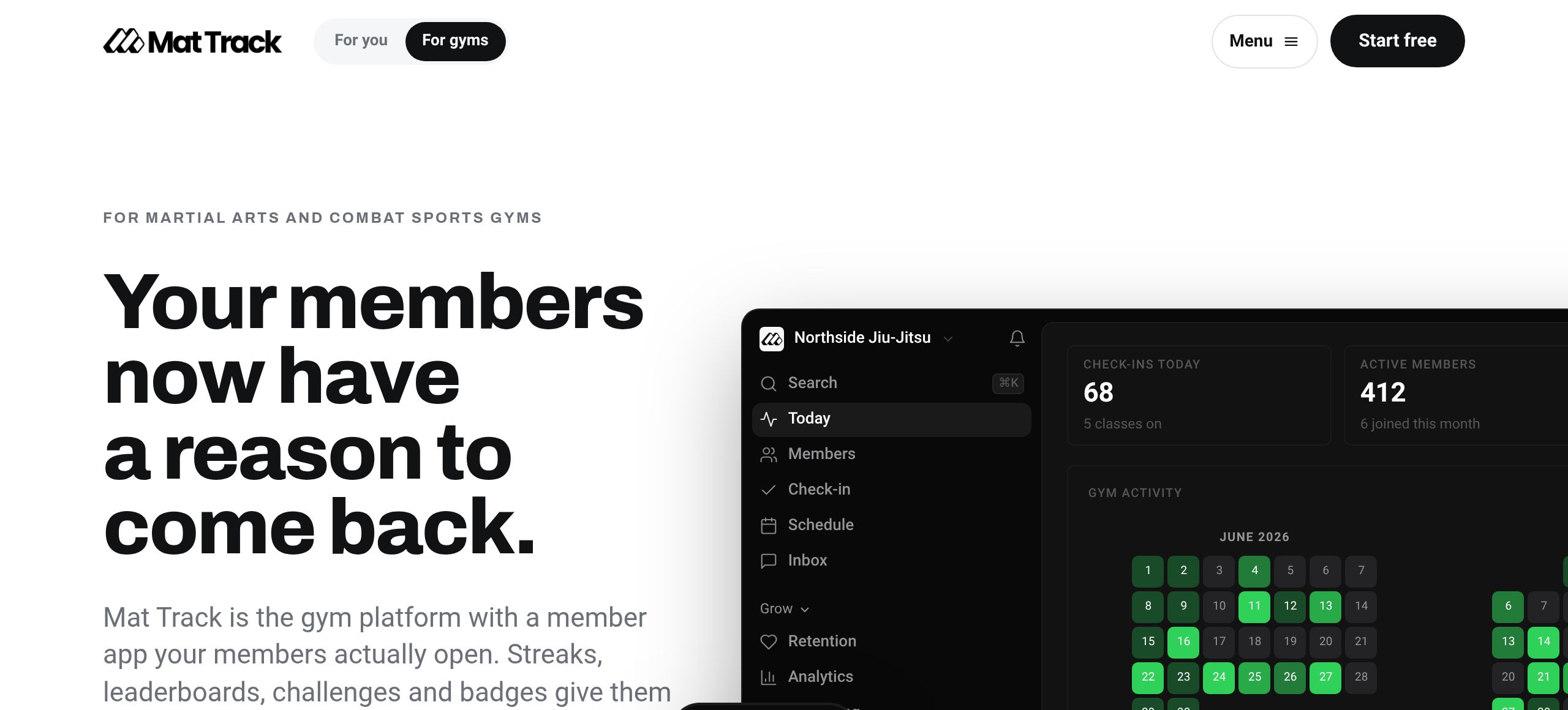
Mat Track is ours, so judge accordingly. Starter at $49 a month for up to 100 active members, with the member app, community features, check-in, scheduling, waivers and payments included; Growth at $99 a month and Pro at $199, with no platform transaction fees and a 7-day free trial. The reason to pick it is retention: attendance feeds each member's own 60-day pattern and flags the drops, which is the mechanism that keeps members rather than just counting them. The honest limitation: it is the youngest platform on this list, and if you want a marketplace that brings you strangers, it does not have one.
Where it wins:
- Every plan, Starter included, carries the member app and community features, not a stripped demo
- Attendance drives retention alerts against each member's own 60-day pattern (Growth and Pro)
- No platform transaction fees on any plan
Where it falls short:
- Youngest platform on this list, with the shortest track record
- No consumer marketplace to bring in walk-ins
- No free plan; a 7-day free trial, then from $49 a month
Gymdesk, from $75 a month for up to 50 active members rising to $200 for 151 to 250 with Gymdesk Payments ($100 to $240 with your own processor, as of October 2026), is the most-used platform in our crawl at 27%. Everything is included at every tier, with a website builder bundled, and it is the strongest pick if you want one simple bill and a clean setup day. Its retention tooling is lighter than its booking tooling.

Where it wins:
- Most-used platform in our crawl at 27%
- Every feature at every tier, website builder included, one predictable bill
- Fast, simple setup with month-to-month billing
Where it falls short:
- Retention tooling is thin next to its booking tooling
- Price climbs with member count; $200 a month by 400 active members
- Member-facing app is functional rather than something members open daily
Zen Planner, from $99 a month plus modules: website $99, marketing automation $249, branded app $39. It has real depth for larger operations, belt tracking included, but the configured price is the thing to check; core plus website plus app plus marketing passes $480 a month, which is a different product category from its headline price.

Where it wins:
- Real depth for larger and multi-programme operations, belt tracking included
- 20% share in our crawl; a proven choice at scale
- Staff, payroll and organisational features the simpler tools lack
Where it falls short:
- The add-on stack: website $99, marketing $249, app $39, so the configured price can pass $480 a month
- Heavier setup and learning curve than anything else here
- Owned by Daxko; product direction follows a large portfolio, not just gyms
Kicksite, $49 to $199 a month by student count, is the martial-arts-only veteran, strong on belts, gradings and family billing. At 17% share in our crawl it clearly retains the traditional clubs it serves. The trade-off is a dated feel and a thinner member-facing app than the newer platforms.

Where it wins:
- Built only for martial arts: belts, gradings and family billing are first-class
- Cheapest paid entry here at $49 a month for small clubs
- 17% crawl share shows it keeps the traditional clubs it serves
Where it falls short:
- Dated interface next to the newer platforms
- Thin member-facing app, so members have little reason to open it
- Feature set tops out early for gyms wanting automation or analytics
Mindbody publishes no prices; you book a call. Its case is discovery: in large cities its consumer marketplace genuinely brings in new bodies, and it held 10% share in our crawl. For a membership-based fight gym, you pay studio-platform money for marketplace surface a muay thai gym mostly cannot use.

Where it wins:
- The consumer marketplace genuinely brings walk-ins in large cities
- Biggest brand in the room, with the integrations that follow
- Strong for class-pack and drop-in business models
Where it falls short:
- No public pricing; a sales call to learn the number
- Built for studios and wellness, so gradings, belts and fight teams are foreign concepts
- You pay for marketplace surface most muay thai gyms cannot use
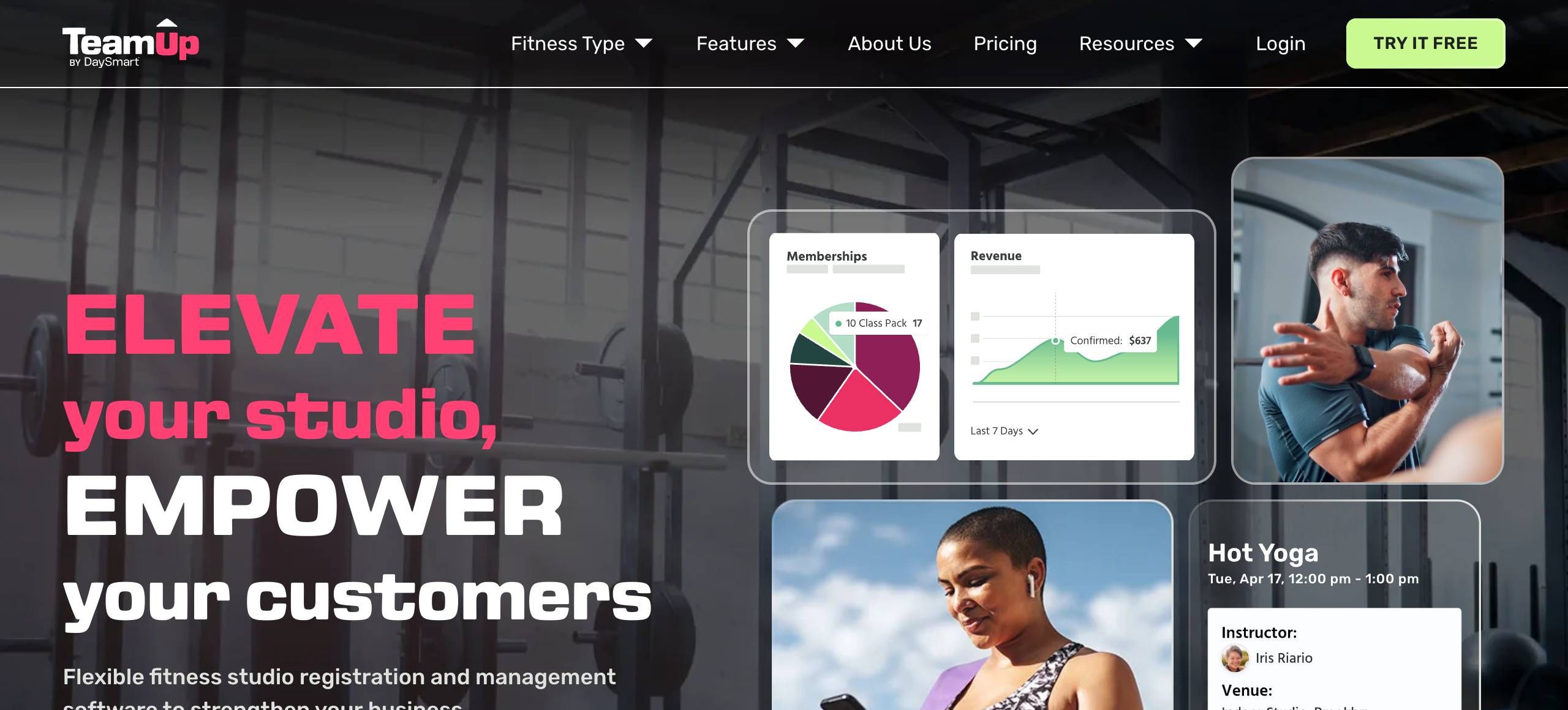
TeamUp prices by active customers, for example $189 a month at 101 to 200, with a branded app at $99 extra. Month to month, no setup fees, and particularly strong in the UK through GoCardless direct debit. It is timetable-first software: excellent bookings, but retention and belt progression are not its language.
Where it wins:
- Excellent bookings and timetabling, priced by active customers
- Strongest UK story through GoCardless direct debit
- Month to month, no setup fees, straightforward migration help
Where it falls short:
- Retention and belt progression are not its language
- Branded app is a $99 a month add-on
- Studio vocabulary; martial arts structures need workarounds
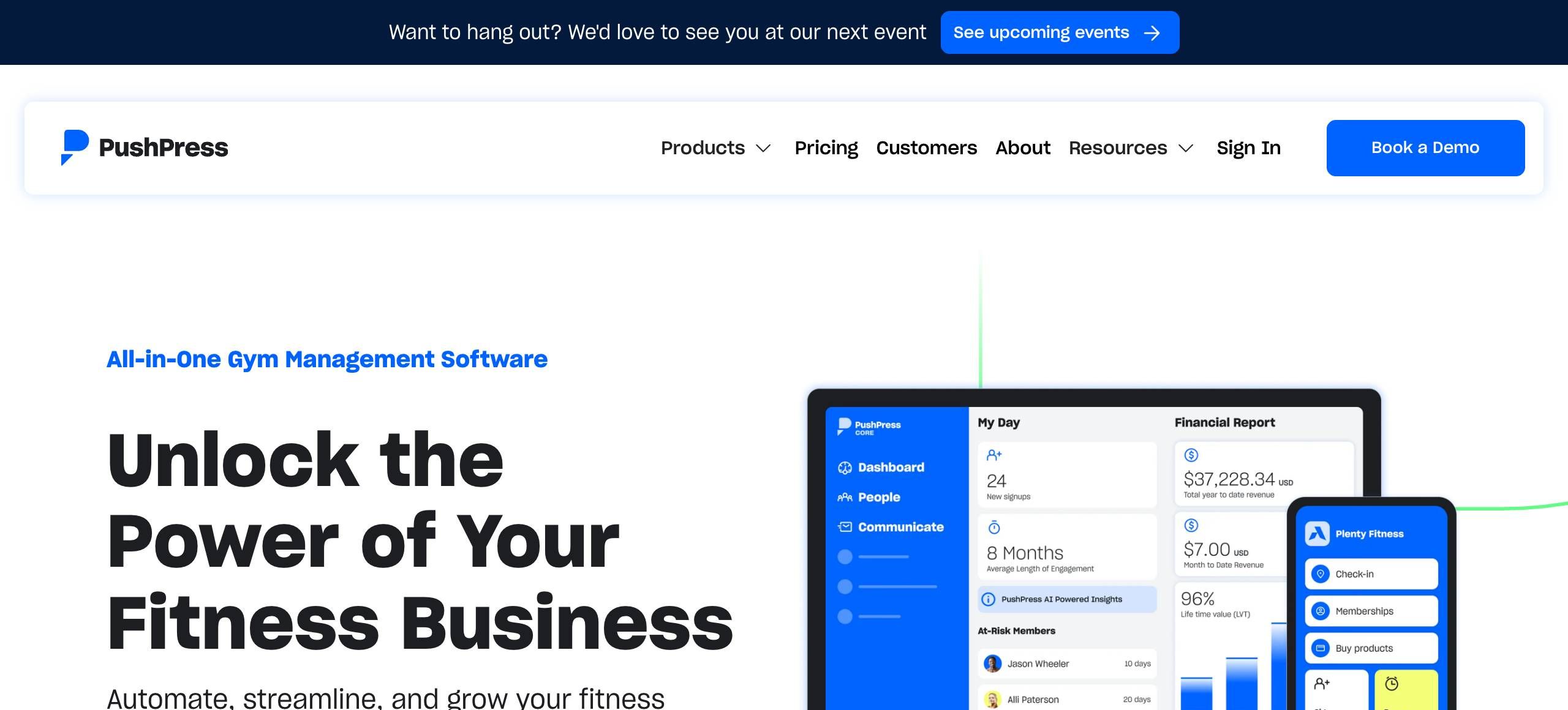
PushPress starts free with unlimited members, then Pro at $159 and Max at $229, with add-ons such as its training product from $79 and a branded app from $81. Its DNA is CrossFit-style class gyms, which maps well onto muay thai's class structure. The free tier is real, but the pieces a fight gym wants tend to live in the add-ons, so price the configured version.
Where it wins:
- The free tier is real: no monthly fee, unlimited members
- Clean modern product with strong check-in flow
- CrossFit-style class DNA maps well onto muay thai timetables
Where it falls short:
- The pieces a fight gym wants sit in paid add-ons (training from $79, branded app from $81)
- Pro at $159 and Max at $229 price above most rivals here once configured
- No belt or grading structure out of the box
How to choose software for a muay thai gym
Under a hundred members and cost-sensitive: start on PushPress's free tier or a 7-day free Mat Track trial (then $49 a month) and feel the difference in your own evening rush before paying anyone. Traditional club with belts, kids programmes and family billing: Kicksite or Zen Planner. One bill, no fuss, website included: Gymdesk. UK gym on direct debit: TeamUp. Chasing walk-in volume in a big city: that is the one honest Mindbody case. And whatever you pick, make the trial concrete: run one real Tuesday evening through it, from check-in to a new member signing a waiver, before you migrate anything.