
Blog · For gyms · comparisons
Best Gymdesk alternatives for martial arts gyms (2026)
Six Gymdesk alternatives compared with vendor-verified pricing, real screenshots and honest trade-offs, plus the case for staying where you are.
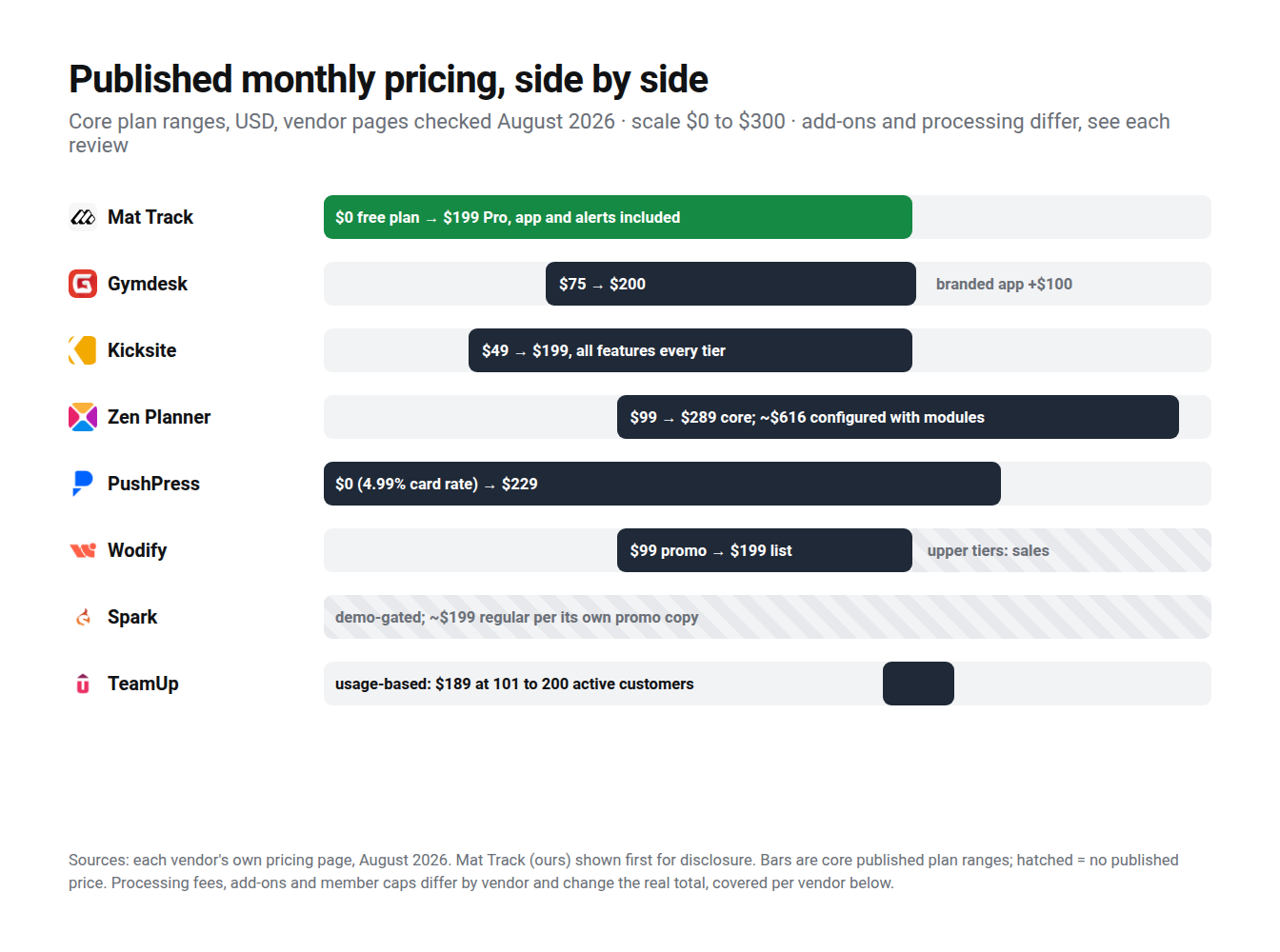
The short version: most gyms looking past Gymdesk are trying to fix one of three things: the $100-a-month branded app fee, basic belt tracking, or reports where they wanted retention alerts. Below are six alternatives with vendor-verified pricing as of August 2026, one honest paragraph on why you might stay, and a chart to put every published price on one axis.
Why gyms go looking for a Gymdesk alternative
Gymdesk earns its install base. In our August 2026 crawl of 5,191 martial arts gym websites it was the most-detected platform, it holds a 4.8 rating across roughly 150 Capterra reviews, and its pricing is admirably plain: $75 to $200 a month by member count, every feature at every tier, month to month. Reviewers consistently praise how easy it is to run; the recurring gripe is limited customisation.
The gyms that outgrow it name specific gaps. The member app costs $100 a month on top of the plan, which nearly doubles the bill at the small end. Rank tracking is basic, which pinches once a gym runs BJJ and striking side by side. And retention is a reports page you remember to open, not an alert that finds you when a member's attendance slips. If none of those three bothers you, the honest advice is further down; if one of them is your daily irritation, here is the field.
Mat Track, the retention-first alternative
Full disclosure first: Mat Track is our product, built inside a jiu-jitsu academy, so weigh this entry accordingly. It exists for the third gap above. Every member is watched against their own 60-day attendance pattern and drops are flagged while a message can still change the outcome; ranks run across multiple arts with grading criteria members read in the app; and the member app, streaks, badges, leaderboards and a community feed, is included in every plan rather than sold as an add-on. Pricing is a 7-day free trial, then $49 Starter for up to 100 active members, $99 Growth (where retention alerts start), $199 Pro, billed monthly, no platform transaction fees, as of October 2026.
Mat Track's AI front desk, Marty, is now in early access: see how the alternatives compare on AI.
Where it wins:
- Retention alerts on Growth and Pro; streaks, badges and comeback challenges in every plan.
- Multi-art rank ladders with criteria visible to members.
- Takes nothing from your payments, ever.
Where it falls short:
- No website builder, where Gymdesk includes one.
- There is no free plan, only a 7-day free trial before Starter at $49.
The full switch-focused comparison is on our Gymdesk switching page, and the bill itself is dissected in Gymdesk pricing explained.
Kicksite, the belt administration specialist
Kicksite is martial-arts-first software with the deepest belt tooling of anything here: custom rank curricula, testing events, one-click promotion of eligible students and a full promotion history. Pricing is simple, $49 a month for up to 25 students rising to $199 at 101 and up, all features at every tier, as of August 2026.

Where it wins:
- Belt and testing administration.
- Simple tiered pricing with nothing gated.
- A long record with traditional schools.
Where it falls short:
- Students get a mobile web portal rather than a native app.
- Automation centres on expiring memberships and overdue invoices rather than attendance.
- At 150 students it costs more than some full platforms here.
Our Kicksite switching page has the detailed side-by-side.
Zen Planner, the veteran with a module bill
Two decades of martial arts pedigree, native belt testing, and a real website product make Zen Planner the most established alternative. The bill is modular: the core runs $99 to $289 a month across eight member-count tiers, and the branded app ($39), website ($99) and Engage marketing ($249) stack on top, taking a configured 150-member school to about $616 a month, as of August 2026.
Where it wins:
- Martial arts pedigree and native belt testing.
- A website from the same vendor.
- Month-to-month billing by default.
Where it falls short:
- The module bill climbs fast, our Zen Planner pricing breakdown walks the full tier table.
- Retention is reporting plus a $249 marketing module.
- The price steps are steepest at the small end, so a growing school's bill can nearly double before its revenue does.
PushPress, the free plan with a card rate
PushPress publishes everything, which is rarer than it should be: Free at $0 with unlimited members, Pro at $159, Max at $229, and the processing rates in the open. The catch is where free earns: 4.99% plus 30 cents on cards against 2.89% on Pro and 2.75% on Max, which makes Free cheaper only below roughly $7,600 a month in card volume. Rank tracking lives in the paid tiers.
Where it wins:
- A genuinely free plan with no member cap.
- Total pricing transparency, rates included.
- Polished modern software.
Where it falls short:
- The free plan's 4.99% card rate gets expensive once you take real money by card; the arithmetic is in our PushPress pricing breakdown.
- Belts require Pro at $159.
- Martial arts is a vertical rather than the product's centre.
Wodify, performance tracking with quoted uppers
Wodify brings real retention machinery, at-risk flags and weekly streaks, plus the strongest workout-performance tracking here, and most of its martial arts base is BJJ. The buying is the hard part: Essentials lists at $199 a month per location, promoted at $99 with a demo as of August 2026, while the Accelerate and Ultimate tiers, where belt tracking lives, carry no published price, and cards process from 2.7% plus 30 cents.

Where it wins:
- Performance and whiteboard culture.
- Genuine at-risk identification.
- Strong BJJ presence.
Where it falls short:
- Belt tracking sits in unpriced tiers.
- There is an onboarding fee, and the amount is not published.
- It takes a cut of every card payment, from 2.7% plus 30 cents.
The fuller comparison is on our Wodify switching page.
Spark Membership, the sales machine at a flat price
Spark was the fourth most-detected platform in our crawl, a bigger footprint among martial arts schools than its press suggests. It packages funnels, landing pages, SMS marketing, point of sale and a member app, with an account rep doing setup. It charges one flat price at any school size, $199 a month on its pricing page and annual plan or $249 month to month on its offer page, as of October 2026, with text credits and card processing on top.

Where it wins:
- Student acquisition tooling in one package.
- Genuine martial arts focus.
- A real install base.
Where it falls short:
- One flat fee at any size, so a small school pays the same $199 to $249 a month as a large one.
- Retention alerts are not part of the pitch.
- Setup is rep-led rather than self-serve.
Details on our Spark switching page.
TeamUp, the fair generalist
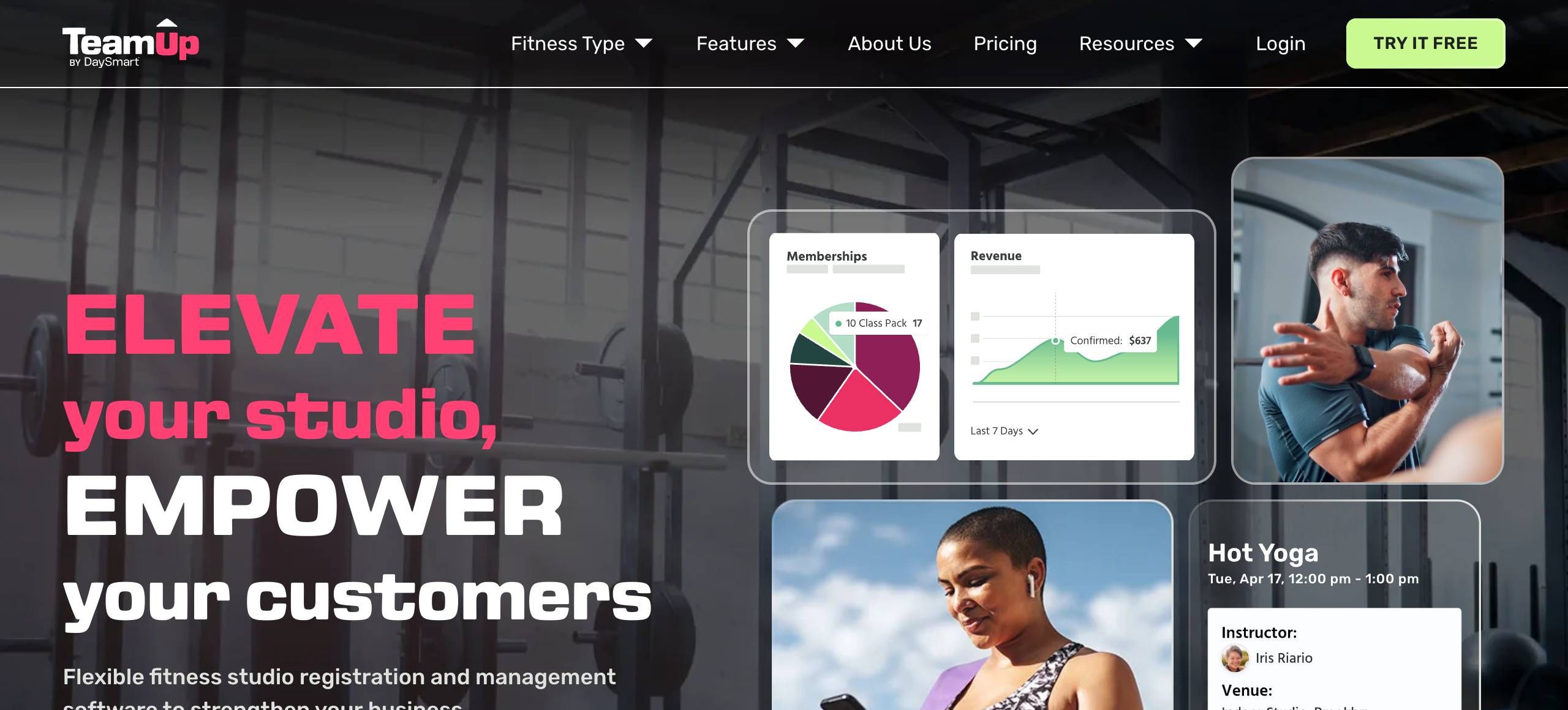
TeamUp prices by active customers who actually show up in a month, $189 at the 101 to 200 tier, with no setup fee, no contract and a member app included; the branded version is $99 extra. It is honest, well-liked software whose limitation for this audience is simple: belts, gradings and ranks are absent from the advertised product, and only 0.7% of software-running gyms in our crawl use it.
Where it wins:
- Unusually fair usage-based pricing.
- Month-to-month with no exit cost.
- Clean multi-programme scheduling.
Where it falls short:
- No belt, grading or rank features at all.
- The branded app is an extra $99.
- Barely present in martial arts, so peer references are scarce.
More on our TeamUp switching page.
Gymdesk alternatives with AI for the front desk
Five of the six other alternatives sell AI, as of 19 October 2026: Zen Planner, PushPress, Wodify, Spark Membership and TeamUp. Kicksite, like Gymdesk, markets none. None of the five says its AI can refund a member. Mat Track's Marty, in early access, drafts the reply and sets up the Stripe refund, and your team approves both.
| Software | Its AI, 19 Oct 2026 | Who has the final say |
|---|---|---|
| Mat Track | Marty (early access): drafts member email and text replies, sets up Stripe refunds and cancellations, answers staff questions from your records | Your team, before anything is sent or refunded |
| Gymdesk | None advertised | No AI |
| Kicksite | None advertised | No AI |
| Zen Planner | Engage AI (separate product, from $249 a month): answers calls, texts, web chat and DMs; books trials | The AI |
| PushPress | AI Assistant (Pro, Max): answers questions, pauses or cancels plans, applies charges; no refunds listed. Conversation AI for texts, DMs and web chat (Grow add-on, $329 a month plus message fees) | Assistant: you, it asks first. Conversation AI: you or the AI, your setting |
| Wodify | Ask Wodify (every plan, monthly credits): answers data questions, cancels memberships, sets holds; no refunds listed | Not stated |
| Spark Membership | SparkAI: text and website bots that chat and book appointments; an email writer | The AI, for its bots |
| TeamUp | AI Receptionist for web chat and social DMs (Marketing Suite, $109 a month); monthly AI Business Advisor report | The AI |
Sources: each vendor's own website or help centre, checked 19 October 2026: Gymdesk; Kicksite; Zen Planner Engage AI, pricing; PushPress AI Assistant, pricing, Grow; Wodify, Ask Wodify help; Spark SMS, website, email writer; TeamUp Marketing Suite, AI Advisor.
Marty is Mat Track's AI front desk, in early access. Ask him who has gone quiet this month, how many trials joined or whose payment failed, and he answers from your own records with the source beside each answer; owners can also ask about revenue by club and who left and why. Between classes you can ask out loud from his phone app, and he answers in text. Meet Marty or start free and request him.
Gymdesk markets no AI, so leaving it for much of this list means going straight to AI that replies on its own. That buys speed; the cost is finding out what it said after the member does. Marty's reply or refund arrives ready to approve, and nothing goes out until someone at your gym says yes.
How to choose software after Gymdesk
Start from the gap, not the feature lists. If members drift away quietly and you find out at cancellation, prioritise attendance-based alerts and an app members open between sessions; the mechanics of why that timing matters are in our gym member retention guide. If belt administration is drowning the front desk, weight Kicksite and Zen Planner heavily. If cash is the constraint, compare PushPress Free against Mat Track's $49 Starter on your card volume, not their headlines. And whatever you pick, get every price in writing at your member count, with the app, the add-ons and the processing rate on separate lines; half the pain in this market is bills that were never itemised. Mat Track's own numbers are on one page at mattrackapp.com/gyms if you want the disclosed option's baseline while you compare.