
Blog · For gyms · software, pricing
Gymdesk pricing in 2026, what you will really pay
Gymdesk costs $75 to $200 a month up to 250 members on Gymdesk Payments, $100 to $240 on your own processor, plus $100-a-month add-ons. October 2026.
The short version: Gymdesk costs $75 to $200 a month by active members on Gymdesk Payments ($75 up to 50 active members, $100 up to 100, $150 up to 150, $200 up to 250), or $100 to $240 with your own processor, with everything included and no contract. Above 250 members it quotes. The two $100 add-ons, branded app and door access, move the bill most; a 200-member gym with both pays $400. Checked on gymdesk.com/pricing, October 2026.
Gymdesk earns a pricing page explainer for a simple reason: it is the most-used platform among martial arts gyms, appearing on 27% of the 1,146 gym websites with detectable software in our August 2026 crawl of 5,191 sites from our directory. A lot of gym owners are either paying for it or pricing it up. Here is the full picture, every number from Gymdesk's own pricing page.
Gymdesk pricing tiers, by member count
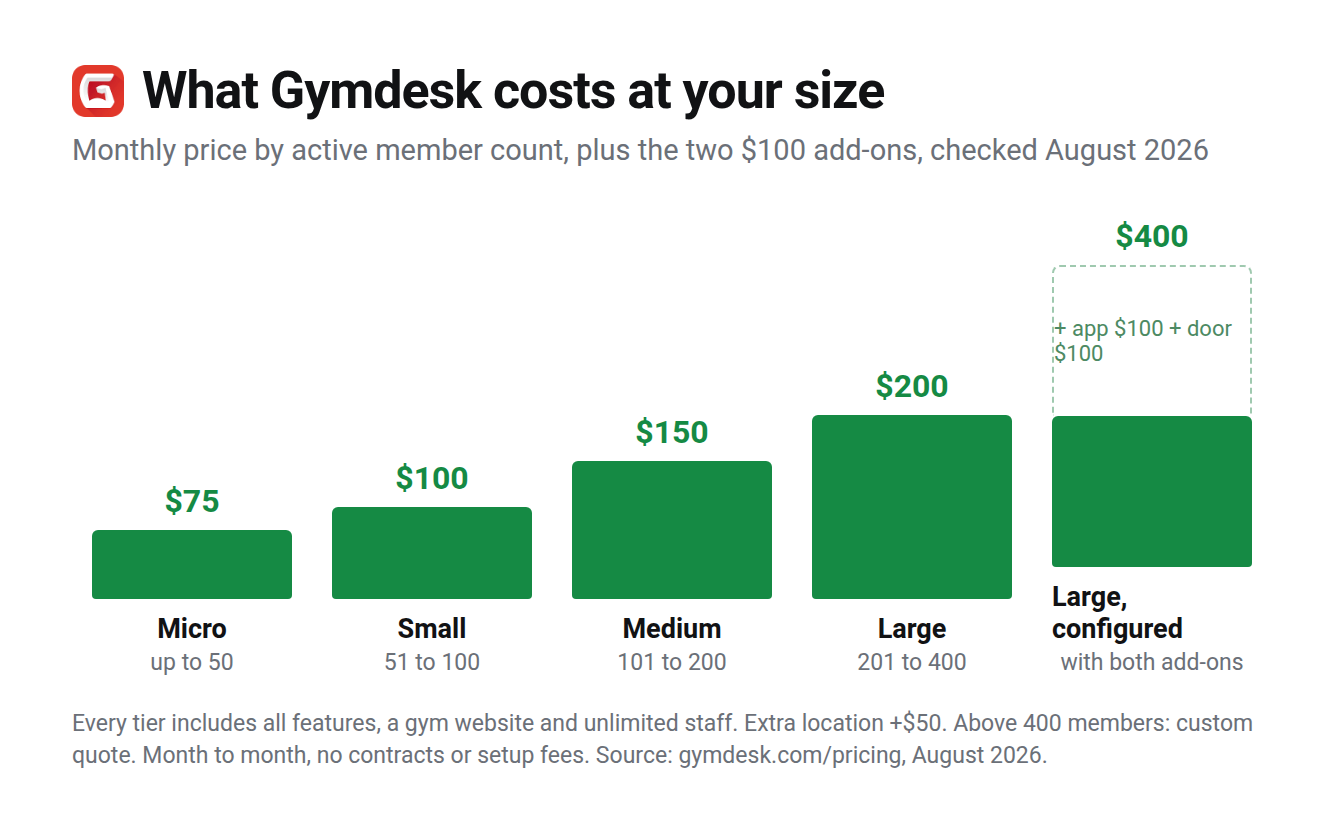
The main axis is active members, and there is a second: who processes your payments, as listed on Gymdesk's pricing page in October 2026. With Gymdesk Payments, $75 covers up to 50 active members, $100 up to 100, $150 up to 150 and $200 up to 250. With your own processor the same tiers cost $100, $125, $175 and $240. Above 250, Gymdesk quotes. Gymdesk Payments runs in the US and Canada; elsewhere, an approved processing partner qualifies for the lower prices, subject to Gymdesk's approval. Nothing else changes between tiers; every plan carries every feature, a gym website builder, and unlimited staff accounts. Billing is month to month with no setup fee, minimum term or cancellation cost, and a second location adds $50 a month on Gymdesk Payments or $100 on your own processor.
That simplicity is rare among the platforms we track. Zen Planner, for example, sells its website ($99 a month) and branded app ($39) as add-ons to its core (October 2026), so the advertised number and the paid number drift apart. Beyond the payments choice, Gymdesk's drift comes from two places: the branded member app at $100 a month, and door access control at another $100 (October 2026) for up to three doors, plus $29 for each door beyond that. A 200-member gym running both pays $400 a month ($440 on its own processor), which is honest money for what is included, but double its tier price.
The three costs to model before joining
The tier you are growing into. Crossing 50, 100 or 150 active members re-prices the account, and past 250 the price is no longer published. A gym at 95 members should budget $150, not $100, because the jump arrives with success, not with warning. The flip side is fair: leads and cancelled members do not count, only active ones.
The add-on decision. The $100 app matters more than it looks. Gymdesk's included member portal is functional, but a gym that wants members opening an app daily, for bookings, streaks or community, either pays the $100 or accepts the portal. Door access is simpler: gyms with 24-hour or unstaffed hours need it, others do not.
Payment processing. You can bring your own processor, but every tier then costs $25 to $40 a month more than on Gymdesk Payments. Gymdesk Payments charges 2.9% plus 30 cents a card payment (3.5% on American Express) and 1% capped at $5 on bank (ACH) payments, per Gymdesk as of October 2026. If your own processor charges half a point less, you save $25 a month on $5,000 of card payments, about the $25 premium at the three smaller tiers, and $50 on $10,000.
How Gymdesk pricing compares, like for like
At the entry level, Kicksite is cheaper at $49 (up to 25 students) and PushPress publishes a free tier, as of October 2026; Mat Track's Starter is $49 for up to 100 active members after a 7-day free trial (October 2026). But entry prices mislead; the fair comparison is configured. A 150-member gym wanting software plus a website pays Gymdesk $150 flat on Gymdesk Payments ($175 on its own processor), while the same gym on Zen Planner pays $229 for the Studio core at that size plus $99 for the website, $328 (the same as its Essentials package), before adding its $39 app. Gymdesk's bundling wins that shape of comparison; on subscription price it loses to PushPress's free tier (which charges 4.99% plus 30 cents on cards, October 2026) and, up to 100 members, to Mat Track's $49 Starter, and it loses to the retention-focused platforms on what the software does with attendance once it has it.
For the wider field at every price point, our muay thai and MMA comparisons carry the full seven-platform charts; Gymdesk holds its own in both.
Where the money verdict lands
Gymdesk is the transparent mid-market option: real prices on a public page, everything bundled, month to month, walk away any time. You pay for that clarity with member-count step-ups, two chunky add-ons and a higher price if you use your own processor rather than Gymdesk Payments or an approved partner, and the retention side of the product is thinner than its booking side. If your gym has up to 100 active members and cost is the constraint, cheaper options exist, PushPress's free tier and ours, Starter at $49 a month after a 7-day free trial (pricing here, and yes, Mat Track is our product, so weigh that sentence accordingly). If you want one predictable bill and a website without a web designer, Gymdesk's pricing is exactly as advertised, which is more than most of this market can say.