
Blog · For gyms · comparisons
Best Kicksite alternatives for martial arts schools (2026)
Mat Track, Martialytics, Gymdesk, Zen Planner, MAAT and Spark compared as Kicksite alternatives: the student app, belt tools and pricing.
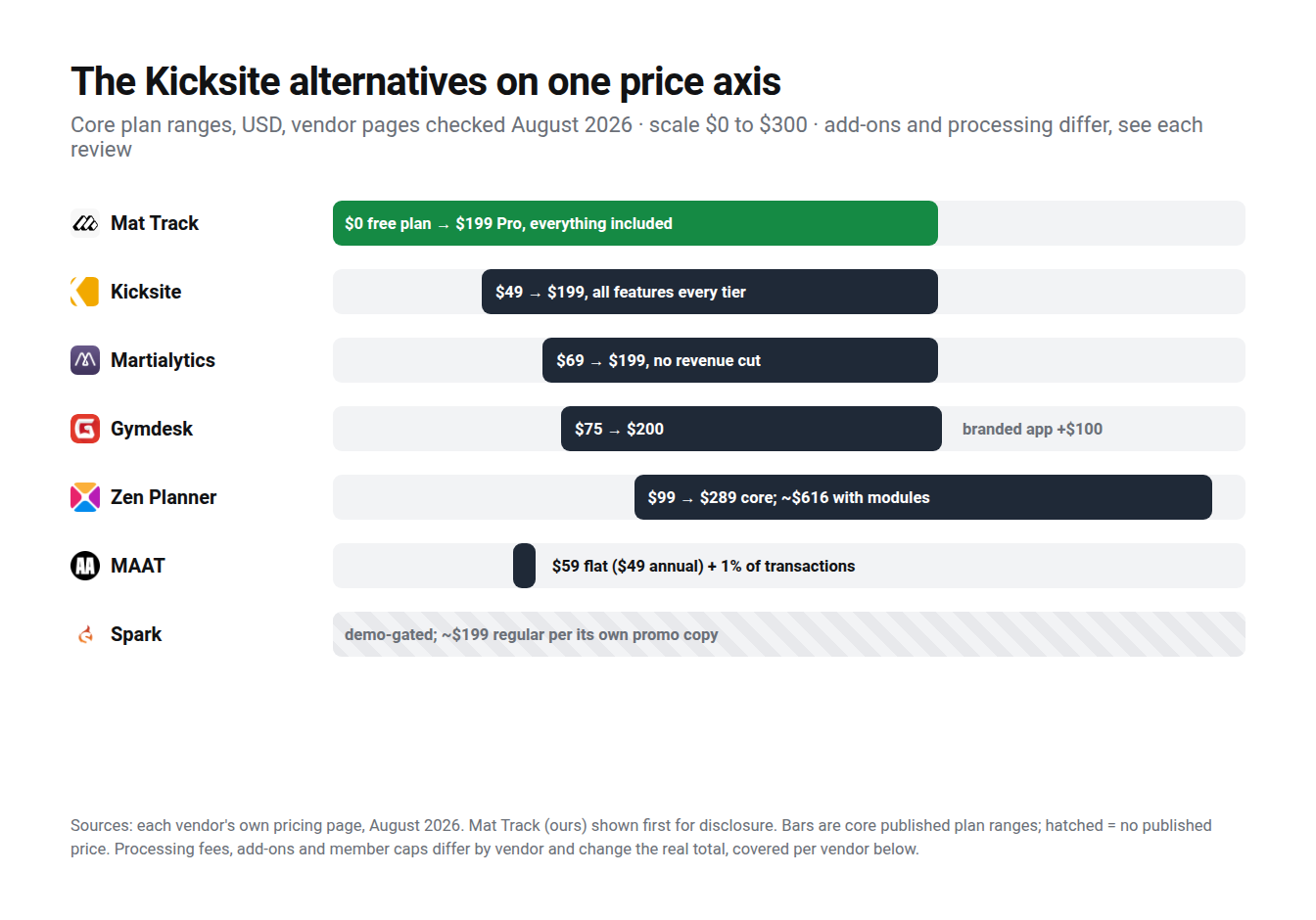
The short version: pick up one of your students' phones and you will find the Kicksite gap, a web portal bookmark where an app should be. Kicksite remains the best belt-administration tool in the market, 4.8 on Capterra and a $199 price ceiling, but schools that want the phone working for retention move on, as of August 2026 usually to Mat Track, Martialytics or Gymdesk. Verified pricing for all of them below.
What Kicksite does brilliantly, and the gap on the student's phone
Kicksite's reputation is earned in the testing room: custom belt curricula, testing events, one-click promotion of eligible students, complete promotion histories. Its pricing is decent too, $49 a month at 25 students to $199 at 101 and up, everything included at every tier, and its 4.8 Capterra rating across roughly 130 reviews leans on an intuitive interface and responsive support. Card processing is billed on top through Kicksite's payment partner; our Kicksite pricing breakdown adds it up for schools of 25, 75 and 120 students.
The limits show in two places. Students reach Kicksite through a mobile web portal, which handles booking and payment but gives them no reason to open it between visits, no streaks to protect, no badges, no feed. And the automation watches money rather than mats: expiring memberships and overdue invoices trigger messages, a fading student's attendance does not. Reviewers add specific workflow gaps, class-specific attendance among them. None of this matters until it does, usually when a school starts asking why quiet students only surface at cancellation.
Mat Track, for the phone and the fade
Ours, so discount accordingly. Mat Track is built around exactly the two Kicksite gaps: a native student app designed for daily habit, one-tap session logging, streaks, badges, leaderboards, challenges and a community feed, and retention alerts that watch each student against their own 60-day attendance pattern and flag the fade while a message still changes it. Belts are covered with multi-art rank ladders and grading criteria students read in the app. A 7-day free trial, then $49 Starter, $99 Growth (where retention alerts start), $199 Pro, no platform transaction fees, as of October 2026.
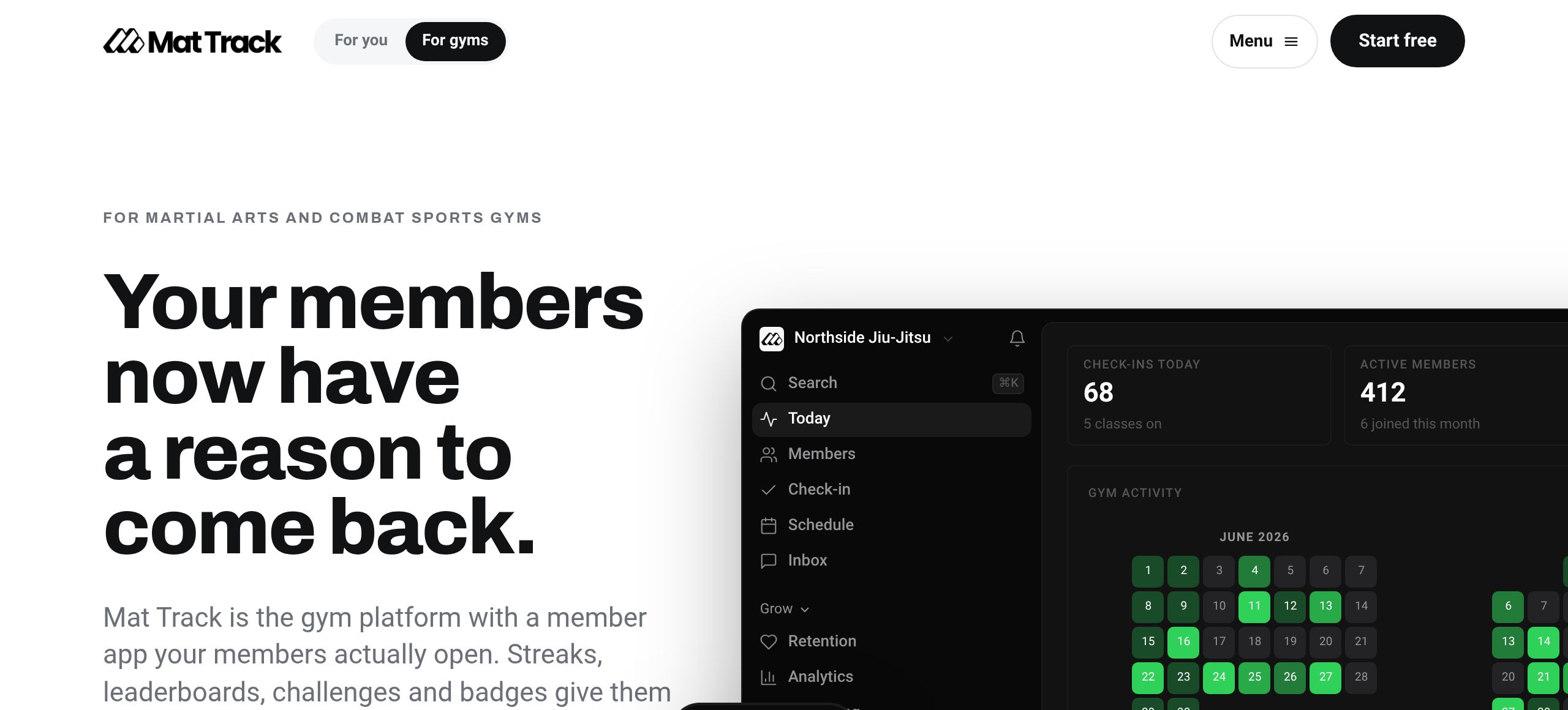
Mat Track's AI front desk, Marty, is now in early access: see how the alternatives compare on AI.
Where it wins:
- Students get a real app they open daily, not a website bookmark.
- Attendance-based alerts and comeback challenges.
- Starter at $49 covers up to 100 active members, where Kicksite's $49 covers 25 students.
Where it falls short:
- Kicksite's testing-event workflow is still deeper.
- No long traditional-school track record.
The side-by-side lives on our Kicksite switching page.
Martialytics, the closest cousin
If you like Kicksite's philosophy, specialist, simple, all-inclusive, Martialytics is the nearest relative: martial arts only, $69 to $199 a month with every feature at every tier, unlimited locations everywhere, a free student app, standard Stripe rates with no revenue cut, and free leads and inactive students. It is a smaller operation with a lighter feature set, and its app covers schedules and updates rather than habit.
Where it wins:
- Kicksite-like simplicity with unlimited locations.
- Fair pricing that undercuts Kicksite at 150 students ($129 against $199).
- A genuinely free student app.
Where it falls short:
- Nothing watches attendance for you; spotting a fading member is still your job.
- Less belt-testing depth than the tool you are leaving.
- A small footprint, 0.8% of crawl installs, so peer references are scarce.
More on our Martialytics switching page.
Gymdesk, for the website and the simplicity
Gymdesk brings what Kicksite never had, a website builder included at every tier, plus the market's largest install base and plainest pricing, $75 to $200 by member count, month to month. The trade is martial arts depth: rank tracking is basic next to Kicksite's, and the branded member app costs $100 a month on top.

Where it wins:
- A website builder is included in every plan.
- Simplest pricing in the market.
- 4.8 Capterra across about 150 reviews and the biggest install base in our crawl.
Where it falls short:
- Belt tracking is basic, a real step down from Kicksite.
- The branded member app costs an extra $100 a month.
- You get reports to check, not alerts that tell you when a member is drifting.
Our Gymdesk alternatives guide covers it from the other direction.
Zen Planner, for module depth at module prices
Zen Planner matches Kicksite's belt-testing maturity and adds the modules, website ($99), branded app ($39), Engage marketing ($249), on top of a core running $99 to $289 by member count. Configured, a 150-member school pays about $616 a month, the full table is in our Zen Planner pricing breakdown. It rates 4.3 on Capterra across 270 reviews, support praised, billing friction the recurring complaint.
Where it wins:
- Belt testing as deep as Kicksite's.
- Two decades of pedigree.
- A real website product.
Where it falls short:
- The module bill dwarfs Kicksite's ceiling.
- The price jumps steeply each time your member count crosses a tier.
- Reviewers report being charged after cancelling, so read the exit terms carefully.
MAAT, the flat-fee minimalist
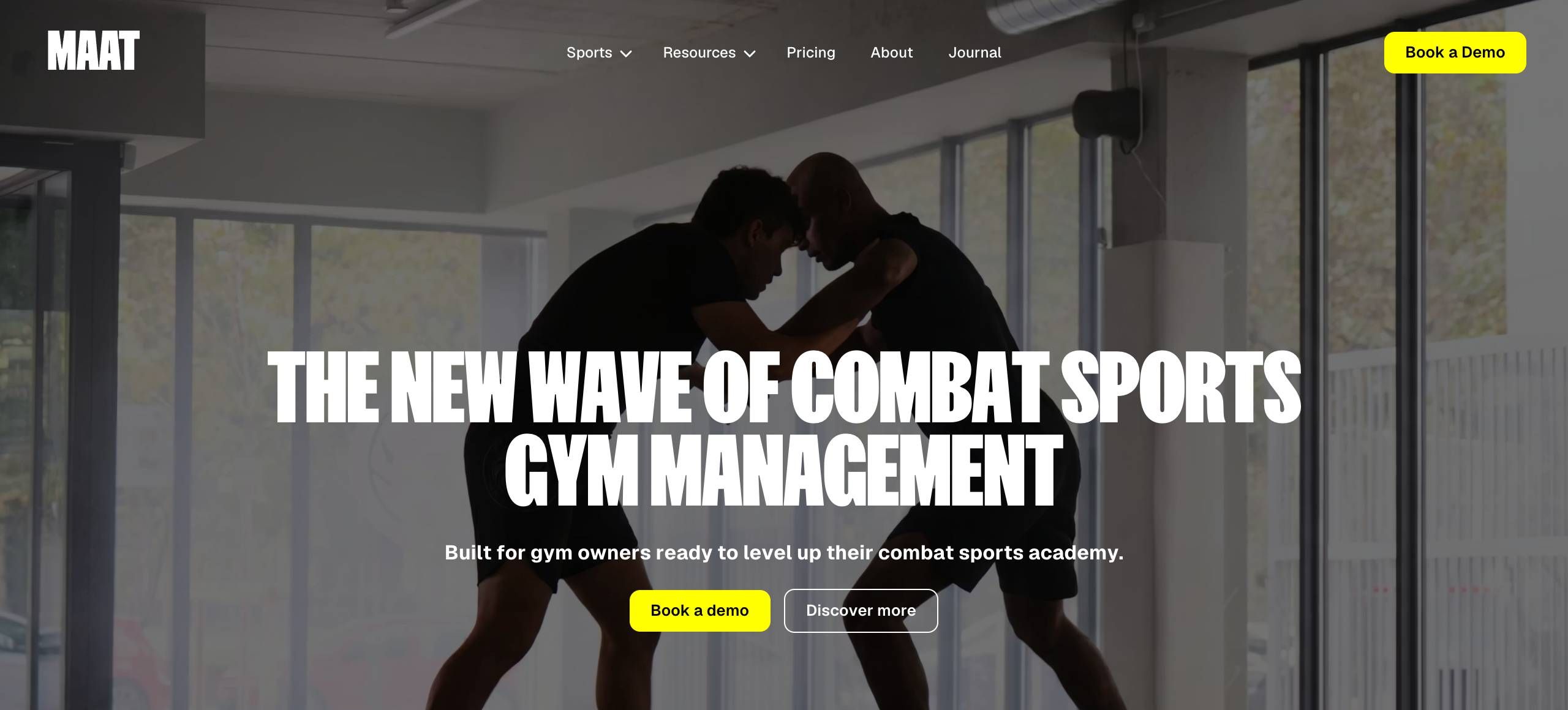
MAAT strips the decision to one line: $59 a month, or $49 billed annually, unlimited members, every feature, cancel anytime, plus 1% of transactions on top of Stripe's own fees. For a large school with modest card volume that is the cheapest subscription on this page; the 1% grows with revenue forever, an $8,000-a-month school effectively pays $139.
Where it wins:
- Unlimited students at $59, undercutting Kicksite's $199 tier badly for big rolls.
- Month to month.
- A simple, widely used student app.
Where it falls short:
- The 1% cut of your payments grows with your revenue, forever.
- No retention tooling.
- Belt features are lighter than Kicksite's.
Details on our MAAT switching page.
Spark Membership, the sales-first outlier
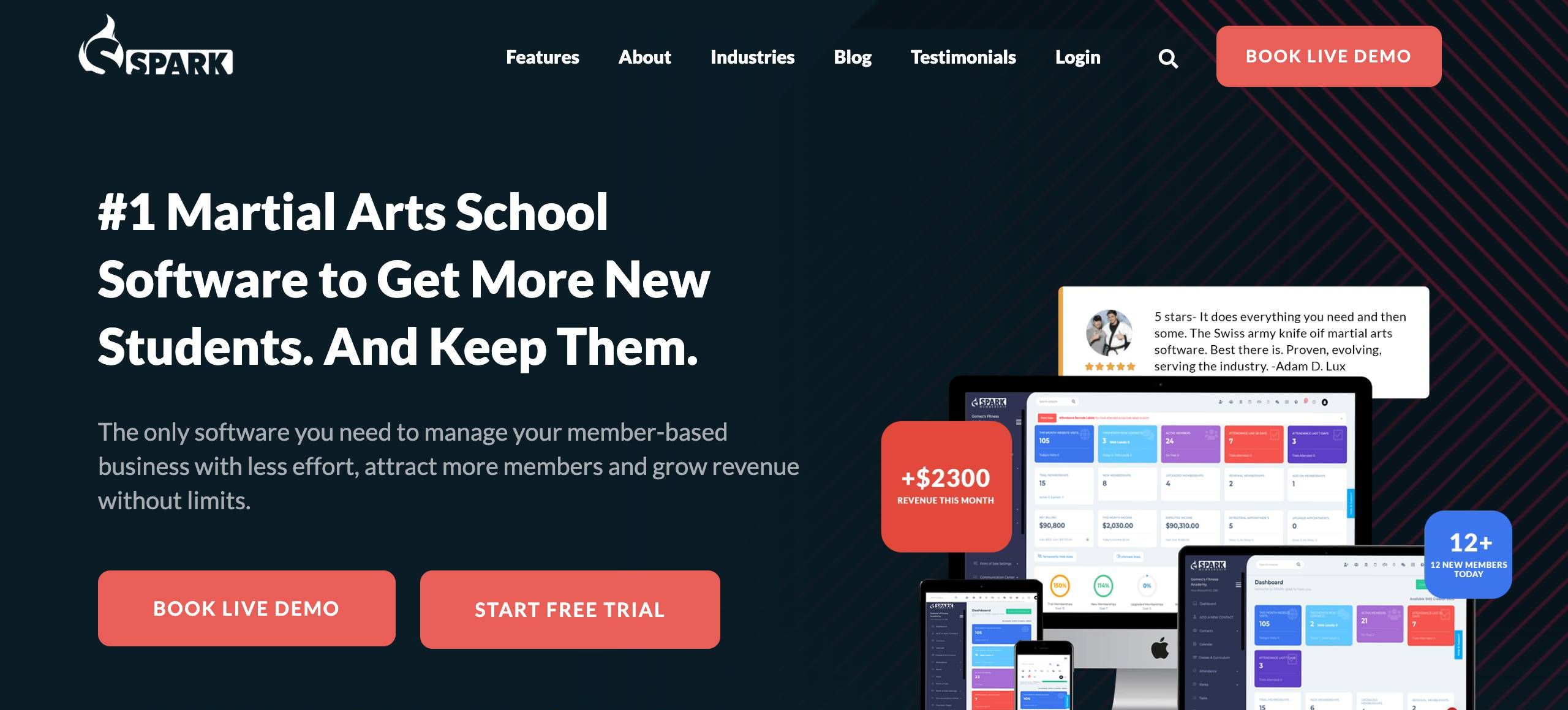
Spark was the fourth most-detected platform in our crawl, with funnels, landing pages, SMS, point of sale and a native member app, sold demo-first with an account rep doing setup. It charges one flat price at any school size, $199 a month on its pricing page and annual plan or $249 month to month on its offer page, as of October 2026, with text credits and card processing on top. Schools whose bottleneck is enrolment rather than administration are its natural fit.
Where it wins:
- Acquisition tooling nothing else here matches.
- Martial arts focus.
- Rep-led setup if you want hand-holding.
Where it falls short:
- One flat fee at any size, so a small school pays the same $199 to $249 a month as a large one.
- Retention alerts absent from the pitch.
- A different product philosophy from Kicksite's admin-first calm.
More on our Spark switching page.
Kicksite alternatives with AI for the front desk
Only two of these alternatives sell AI, as of 19 October 2026: Zen Planner, through its separate Engage AI, and Spark Membership, through SparkAI. Kicksite, Martialytics, Gymdesk and MAAT market none. Neither of the two has AI that drafts replies to your members' emails and texts and sets up Stripe refunds for your team to approve; Mat Track's Marty, in early access, does both.
| Software | Its AI, 19 Oct 2026 | Who has the final say |
|---|---|---|
| Mat Track | Marty (early access): drafts member email and text replies, sets up Stripe refunds and cancellations, answers staff questions from your records | Your team, before anything is sent or refunded |
| Kicksite | None advertised | No AI |
| Martialytics | None advertised | No AI |
| Gymdesk | None advertised | No AI |
| Zen Planner | Engage AI (separate product, from $249 a month): answers calls, texts, web chat and DMs; books trials | The AI |
| MAAT | None advertised | No AI |
| Spark Membership | SparkAI: text and website bots that chat and book appointments; an email writer | The AI, for its bots |
Sources: each vendor's own website or help centre, checked 19 October 2026: Kicksite; Martialytics; Gymdesk; Zen Planner Engage AI, pricing; MAAT; Spark SMS, website, email writer.
Marty is Mat Track's AI front desk, in early access. A parent texts asking whether there is a kids' class on Saturday; Marty drafts the answer from your timetable, prices and policies, and it waits in the inbox until someone at the gym reads it and presses Send. Complaints, injuries and disputes he hands straight to a person, with a note. Meet Marty or start free and request him.
Kicksite markets no AI, so if AI is part of why you're moving, the first question to ask any vendor is who presses Send. Marty does the reading, checking and drafting, the part that eats front-desk hours, and your team makes the call. Every step he takes is logged.
How to choose software after Kicksite
Start with the phone test that opened this guide: if students having a real app, and the school hearing about fading attendance early, is what you are buying, weight Mat Track and read the gym member retention guide for the mechanism. If you want Kicksite's temperament with different economics, Martialytics and MAAT bracket the simple end. If the website is the missing piece, Gymdesk. And if you leave, protect the thing Kicksite did best: export belt histories and testing records first, check the files open, and schedule the cutover away from any grading. Mat Track's pricing is on one page at mattrackapp.com/gyms whenever you want the disclosed baseline.