
Blog · For gyms · comparisons
Best Spark Membership alternatives for schools (2026)
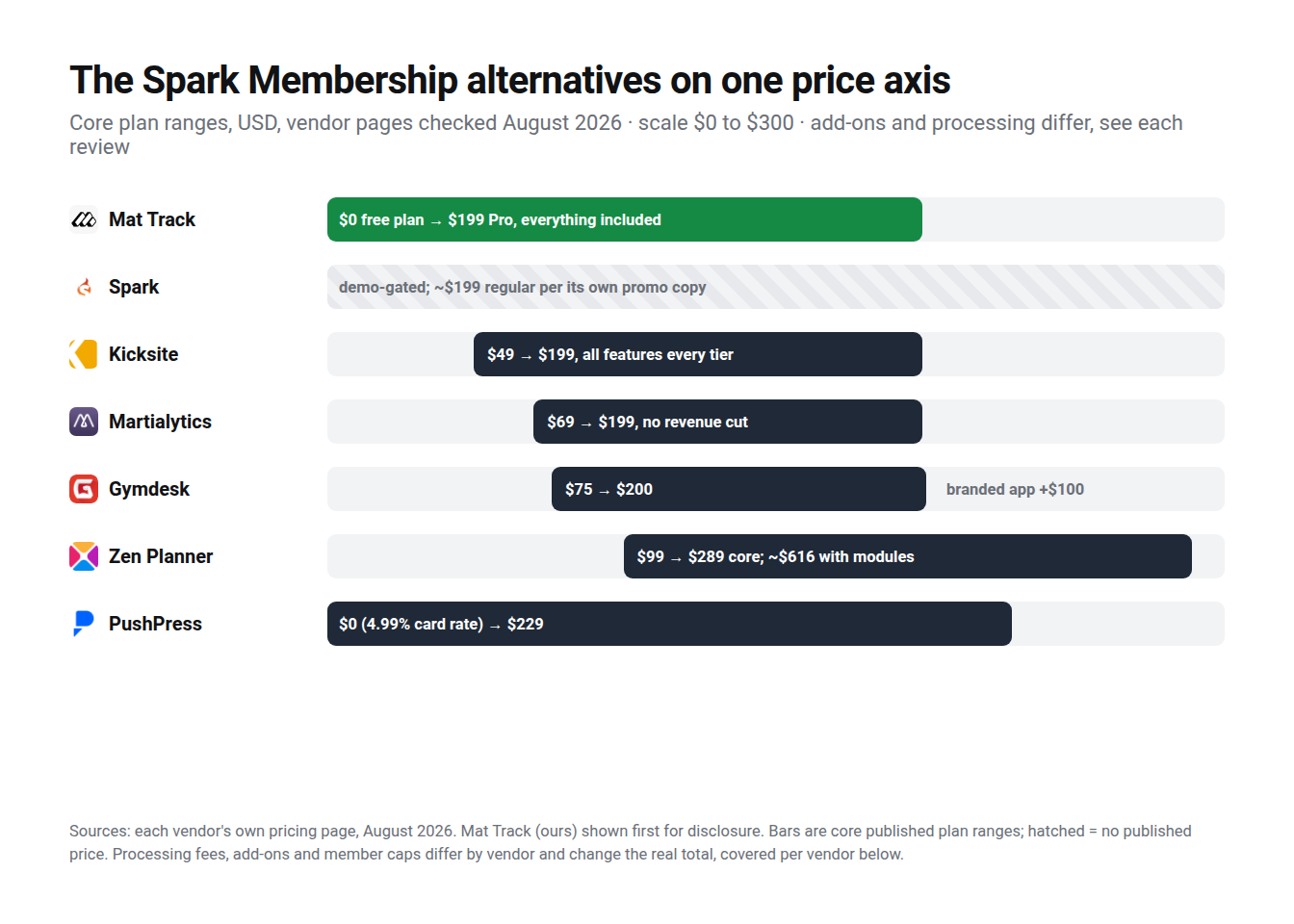
Spark Membership costs $199 to $249 a month at any size. Six alternatives with published prices, compared on getting members and keeping them.
The short version: every school platform serves two columns of the same ledger, getting members and keeping them. Spark Membership is the strongest getting-column specialist in martial arts: funnels, SMS, point of sale and rep-led setup. It charges one flat $199 to $249 a month at any size, as of October 2026, and its keeping column is thin. For keeping members, Mat Track; for a martial arts focus with simple published prices, Kicksite ($49 to $199) or Martialytics ($69 to $199). Six alternatives below, sorted by which column they serve.
The two-column ledger, and where Spark sits
Write your last twelve months as two columns. Getting: enquiries, trials, conversions. Keeping: month-three attendance, quiet quitters, cancellations. Most schools spend on the first column and lose in the second, because a member who leaves after four months takes the whole acquisition cost with them.
Spark is a getting-column machine, and honestly a good one: landing pages, funnels, checkout, SMS campaigns, point of sale, a native member app, and an account rep who builds it with you. Spark charges one flat price at any school size, $199 a month on its pricing page and annual plan or $249 month to month on its offer page, as of October 2026, with text credits and card processing on top, after an 8-week free trial with free student data migration and no lock-in contract (our Spark Membership pricing breakdown works out the full bill). The independent record is thinner, 4.6 on Capterra but across only 11 reviews as of October 2026, which is too few to prove anything in either direction. The keeping column, meanwhile, is tools you drive rather than alerts that find you. Our Spark switching page covers the one-to-one case.
Mat Track, the keeping-column specialist
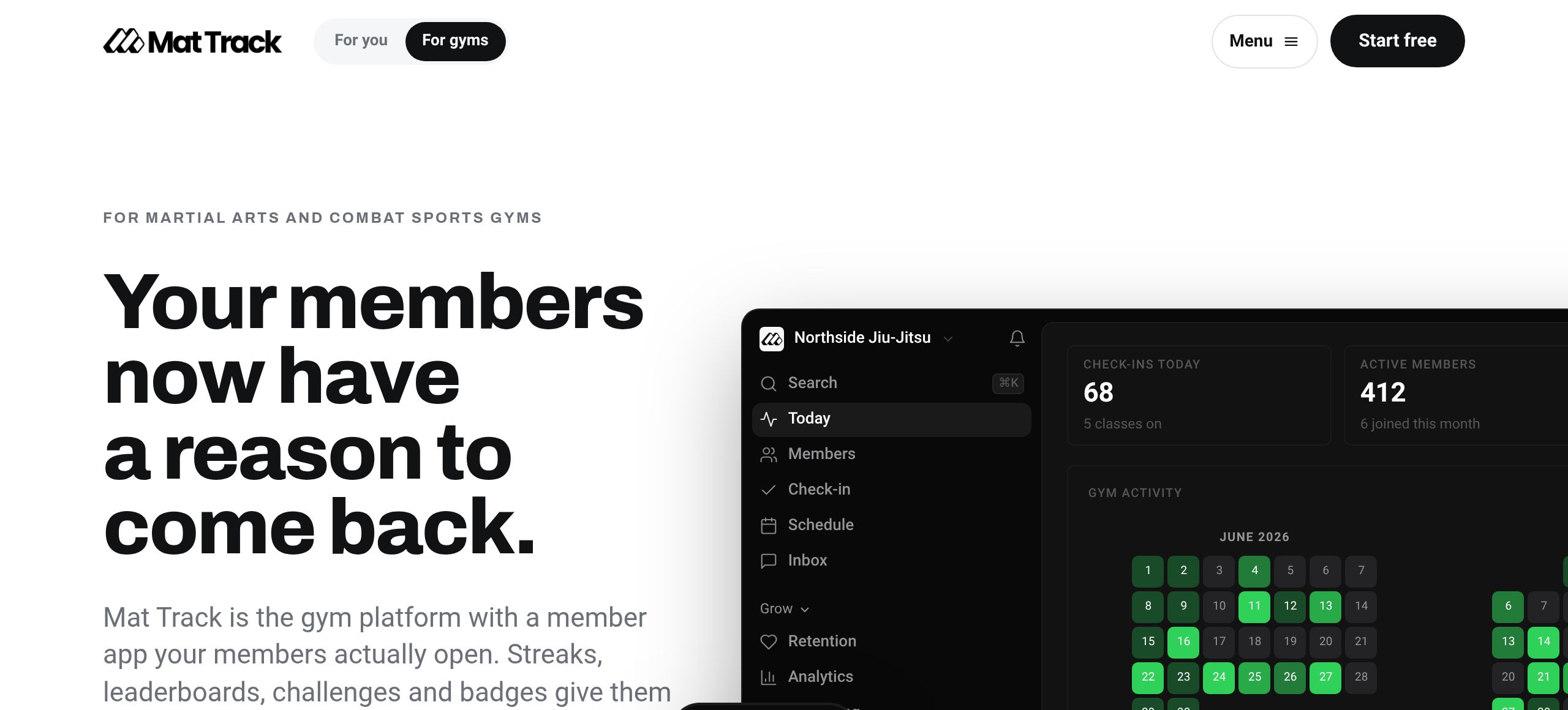
Ours, weigh accordingly, and the mirror image of Spark by design. Mat Track's centre is the keeping column: every member watched against their own 60-day attendance pattern, drops flagged while a message still changes the outcome, comeback challenges with a target attached, and a member app built to be opened between classes, streaks, badges, leaderboards, community. Ranks run across multiple arts with grading criteria in the app. Pricing is public: a 7-day free trial, then $49 Starter, $99 Growth (where retention alerts start), $199 Pro, billed monthly, no platform transaction fees, as of October 2026.
Mat Track's AI front desk, Marty, is now in early access: see how the alternatives compare on AI.
Where it wins:
- Watches attendance and flags fading members, the column Spark leaves to you.
- Priced by size, so a school of up to 100 active members pays $49 a month, or $99 with retention alerts, where Spark charges every school $199 to $249.
- The app gives members reasons to open it daily, which is retention working by itself.
Where it falls short:
- No sales funnels or landing-page builder; campaigns on Growth are lighter than Spark's stack.
- No point of sale with inventory.
- Self-serve setup, where Spark gives you an account rep.
Kicksite, the traditional-school workhorse
Martial-arts-first with the market's deepest belt administration and honest flat pricing, $49 to $199 with everything at every tier, 4.8 on Capterra across roughly 130 reviews. Its automation is transactional, invoices and renewals, and students use a mobile web portal rather than a native app.
Where it wins:
- The best belt-testing and grading administration in the market.
- Flat, published pricing with nothing gated by tier.
- A large verified review base where Spark's is thin.
Where it falls short:
- Students get a website to log into, not a real app on their phone.
- Nothing watches attendance for you; spotting a fading member is still your job.
- No sales-funnel tooling to replace Spark's getting column.
Full treatment in our Kicksite alternatives guide.
Martialytics, simple and published
Martial arts only, $69 to $199 a month with every feature at every tier, unlimited locations, a free student app, standard Stripe rates with no revenue cut, and free leads and inactive students. Small and likeable, 4.7 on Capterra across 21 reviews, with reviewers praising support and wishing for better mobile admin.
Where it wins:
- Simple, fair, published pricing from $69, below Spark's $199 to $249 for any school up to 200 students.
- Belt and grading tracking is built in.
- Free leads, so the getting column costs nothing to store.
Where it falls short:
- Nothing watches attendance for you; spotting a fading member is still your job.
- No funnel or SMS-marketing stack.
- Reviewers wish for better mobile admin tools.
More on our Martialytics switching page.
Gymdesk, the simple incumbent
The most-installed platform in our crawl: $75 to $200 by member count, everything at every tier, website builder included, month to month, 4.8 on Capterra across about 150 reviews. The branded app is $100 extra and rank tracking stays basic.

Where it wins:
- One plain price by member count, from $75 for up to 50 members on Gymdesk Payments ($100 with your own processor), as of October 2026.
- A website builder is included in every plan.
- The most-used platform among martial arts gyms, so help and peers are easy to find.
Where it falls short:
- The branded member app costs an extra $100 a month.
- Belt and rank tracking is basic.
- You get reports to check, not alerts that tell you when a member is drifting.
Subject of our Gymdesk alternatives guide.
Zen Planner, depth on both columns at module prices
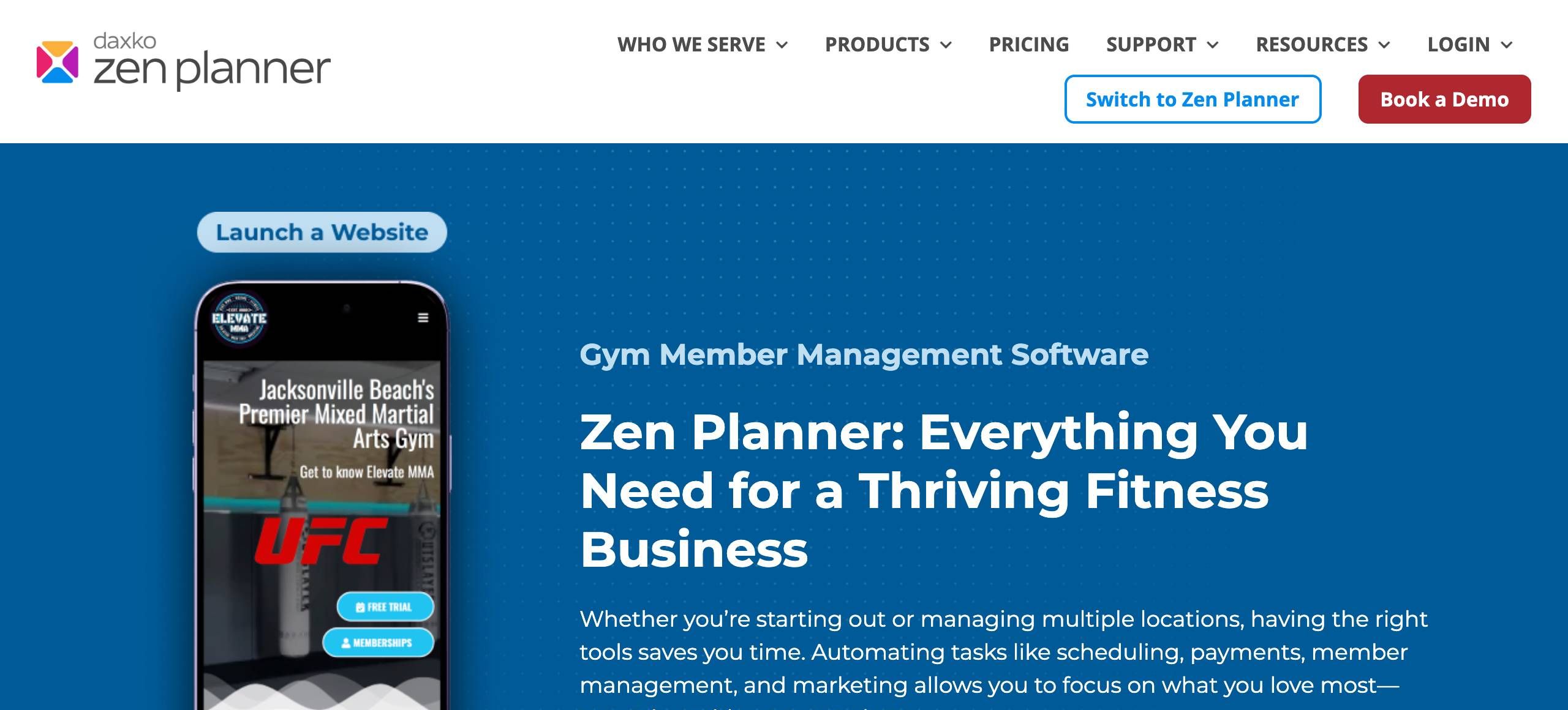
The veteran covers more of both columns than most: native belt testing, a website product, and the Engage marketing module ($249) that goes some way toward Spark's funnel territory, on top of a $99 to $289 core and a $39 app. Configured at 150 members it reaches $517 a month on the Ultimate package with the app, or $616 module by module, as of October 2026; Capterra 4.3 across 270 reviews, support praised, billing friction the recurring complaint. The full table is in our Zen Planner pricing breakdown.
Where it wins:
- The nearest match here to Spark's marketing stack, via Engage or the Ultimate package.
- Belt testing as deep as anything in the market.
- Two decades of martial arts pedigree.
Where it falls short:
- Each member tier adds cost: Ultimate runs from $348 to $538 a month before the app.
- Marketing on its own, through Engage, adds $249 a month on top of the core, as of October 2026.
- Its own reviewers complain about billing, including being charged after cancelling.
PushPress, transparent and modern
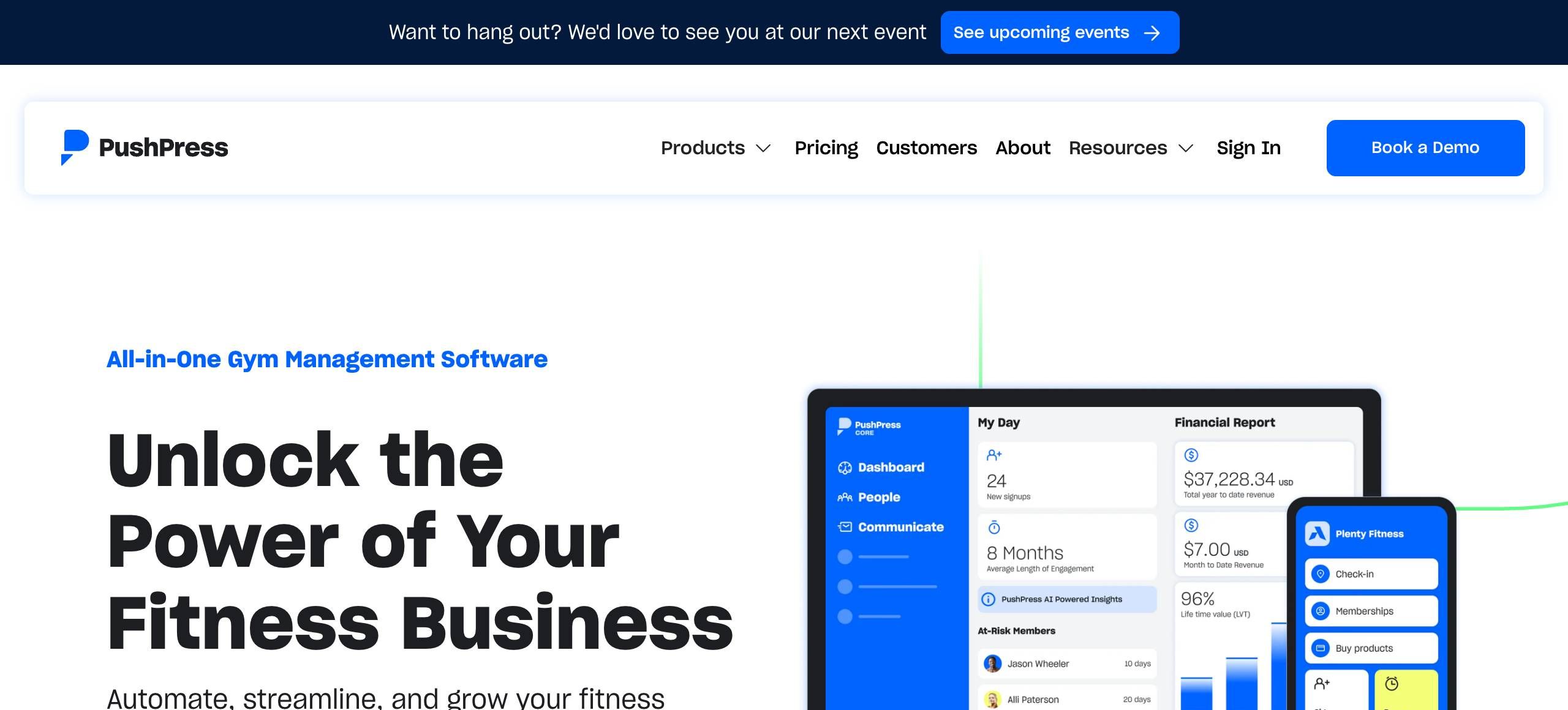
Everything published including card rates: $0 Free with unlimited members at 4.99% on cards, $159 Pro at 2.89% and $229 Max at 2.75%, 4.7 on Capterra across roughly 190 reviews. Its getting column is lighter than Spark's, and it publishes an exact card rate for each plan, where Spark advertised only an average, 2.86%, on an offer page in October 2026. The free-plan maths is in our PushPress pricing breakdown.
Where it wins:
- Every price is public, down to the processing rates.
- A real free tier with unlimited members.
- Modern, well-supported software.
Where it falls short:
- The free plan's 4.99% card rate gets expensive once you take real money by card.
- Belt and rank tracking needs the $159 Pro tier.
- Built for functional fitness first; martial arts is a side room, not the main hall.
Spark Membership alternatives with AI for the front desk
Two of the five other alternatives sell AI, as of 19 October 2026: Zen Planner and PushPress. Kicksite, Martialytics and Gymdesk market none. Spark's own bots and Zen Planner's Engage AI reply on their own and book people in; none of the three says its AI can refund a member. Mat Track's Marty, in early access, works on the members you already have, drafting their replies and setting up Stripe refunds for your team to approve.
| Software | Its AI, 19 Oct 2026 | Who has the final say |
|---|---|---|
| Mat Track | Marty (early access): drafts member email and text replies, sets up Stripe refunds and cancellations, answers staff questions from your records | Your team, before anything is sent or refunded |
| Spark Membership | SparkAI: text and website bots that chat and book appointments; an email writer | The AI, for its bots |
| Kicksite | None advertised | No AI |
| Martialytics | None advertised | No AI |
| Gymdesk | None advertised | No AI |
| Zen Planner | Engage AI (separate product, from $249 a month): answers calls, texts, web chat and DMs; books trials | The AI |
| PushPress | AI Assistant (Pro, Max): answers questions, pauses or cancels plans, applies charges; no refunds listed. Conversation AI for texts, DMs and web chat (Grow add-on, $329 a month plus message fees) | Assistant: you, it asks first. Conversation AI: you or the AI, your setting |
Sources: each vendor's own website or help centre, checked 19 October 2026: Spark SMS, website, email writer; Kicksite; Martialytics; Gymdesk; Zen Planner Engage AI, pricing; PushPress AI Assistant, pricing, Grow.
Marty is Mat Track's AI front desk, in early access. A parent texts asking whether there is a kids' class on Saturday; Marty drafts the answer from your timetable, prices and policies, and it waits in the inbox until someone at the gym reads it and presses Send. Complaints, injuries and disputes he hands straight to a person, with a note. Meet Marty or start free and request him.
SparkAI's bots are built to book new leads and reply on their own; Marty is built for the members you already have, and replies only when your team says so. Letting AI reply on its own buys speed; the cost is finding out what it said after the member does. Marty's reply or refund arrives ready to approve, and nothing goes out until someone at your gym says yes.
How to choose software after Spark, or instead of it
Score your own ledger first. If trials are scarce, Spark's getting column is genuinely hard to beat in this niche, and the honest move is to set its $199 to $249 against every price above and ask for its card rate and text pricing in writing before you sign. If trials come but month-three attendance leaks, buy for the keeping column: attendance alerts, an app with a daily pull, comeback flows, the mechanism is laid out in our gym member retention guide. Mat Track's published list is at mattrackapp.com/gyms for the disclosed baseline.