
Blog · For gyms · comparisons
Best martial arts software, 7 compared (2026)
Martial arts schools run on progression, not memberships. Seven platforms compared with fresh data from 5,191 gym websites and verified pricing.
The short version: martial arts schools run on progression, not memberships, and the best software depends on which mat you own: Mat Track (ours) for retention, Kicksite for belt administration, Spark for enrolment, Zen Planner for depth, Gymdesk for simplicity. Our crawl of 5,191 gym websites shows why one answer doesn't fit, BJJ academies buy software at nearly three times the rate of karate dojos, and each discipline has a different leader. Every price is from the vendor's own page, August 2026 (Mat Track's, October 2026).
The discipline decides more than the feature list
We run 11,000 martial arts gyms on our directory and crawled their websites in August 2026: 5,191 sites loaded cleanly, 1,146 showed detectable booking software, and 78% showed none at all, which means the binder and the spreadsheet are still the market leaders. Among the gyms whose software we could see, Gymdesk leads at 27%, Zen Planner 20%, Kicksite 17%, Spark Membership 15%, Mindbody 10%.
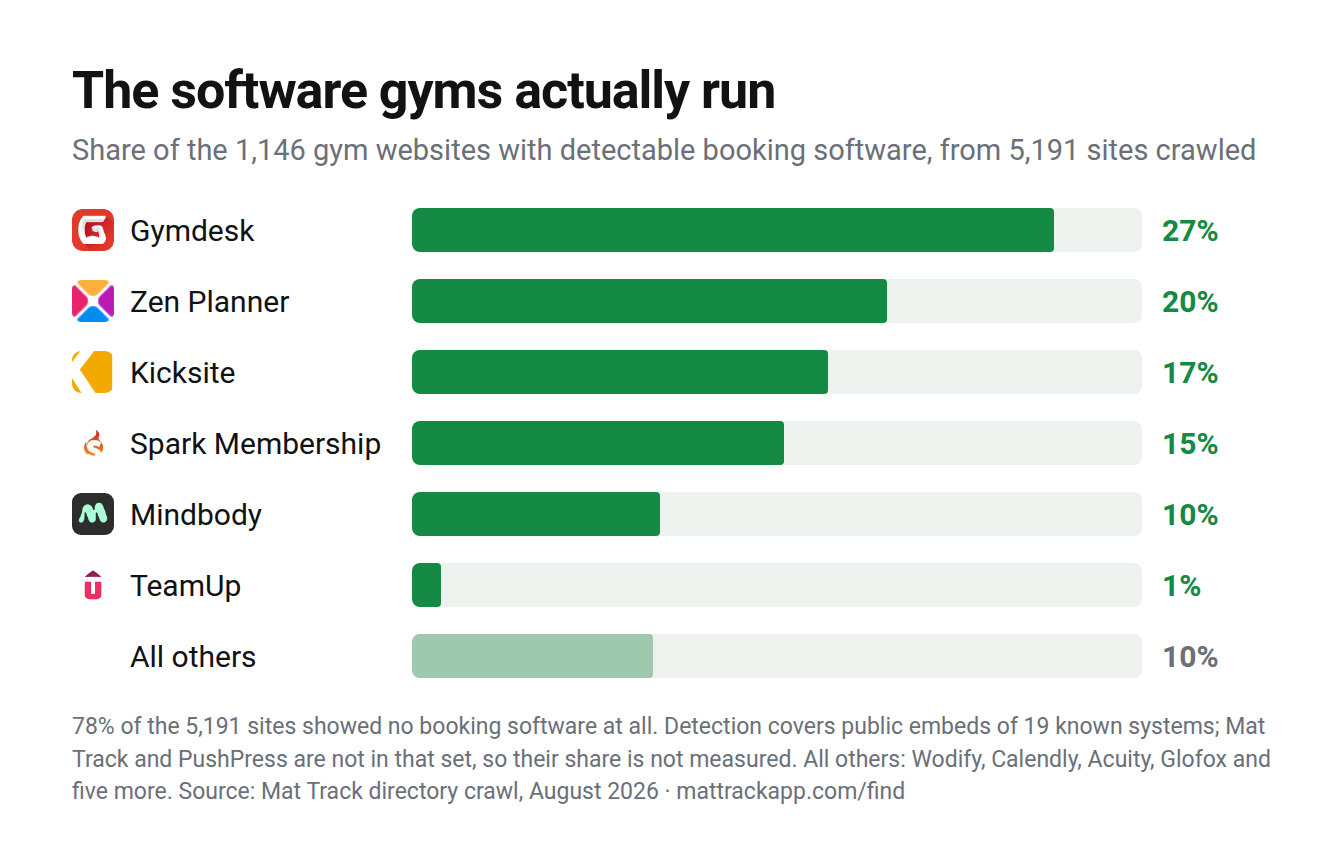
The more useful finding is how much the discipline changes the picture. Thirty percent of BJJ academy sites run detectable software, against roughly one in nine karate and taekwondo schools, and the leaders swap: Gymdesk dominates BJJ and judo, Spark leads karate and taekwondo, Zen Planner is strongest in MMA. The weekly load differs too, a median 16 published classes at a BJJ academy against 8 or 9 at a dojo. That is why this guide has discipline-specific siblings, BJJ, karate, taekwondo, the traditional dojo, MMA, Muay Thai and boxing, and why the reviews below say which mat each platform suits.
What stays constant across disciplines is the shape of the job. A martial arts school is not a gym with different decor: progression is structural (ranks with criteria, not arbitrary levels), revenue clusters around gradings, the paying customer is often a parent, and attrition hides in the plateaus between belts. Software earns its fee on those four or it is just a booking widget.
Mat Track, for retention-driven schools
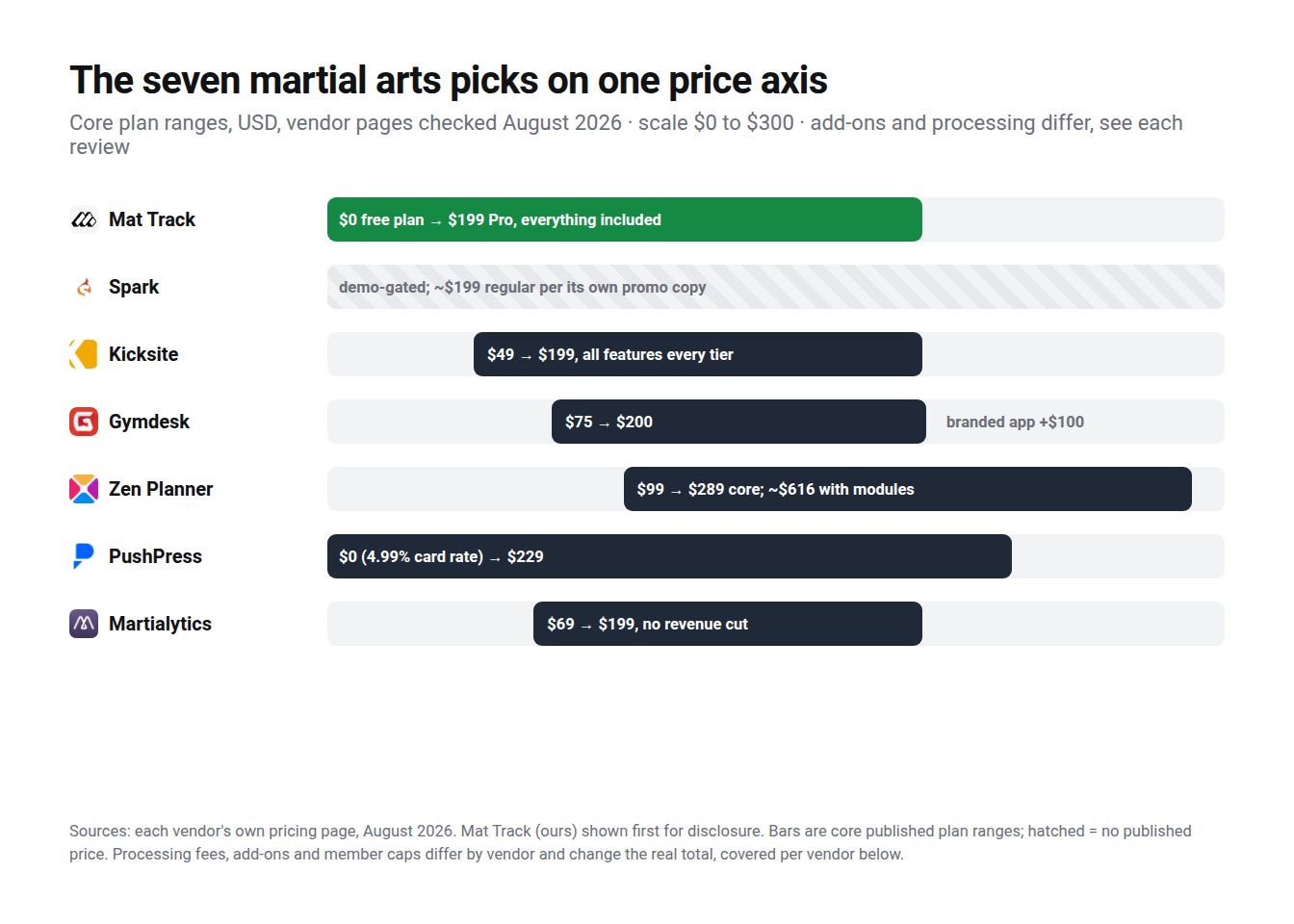
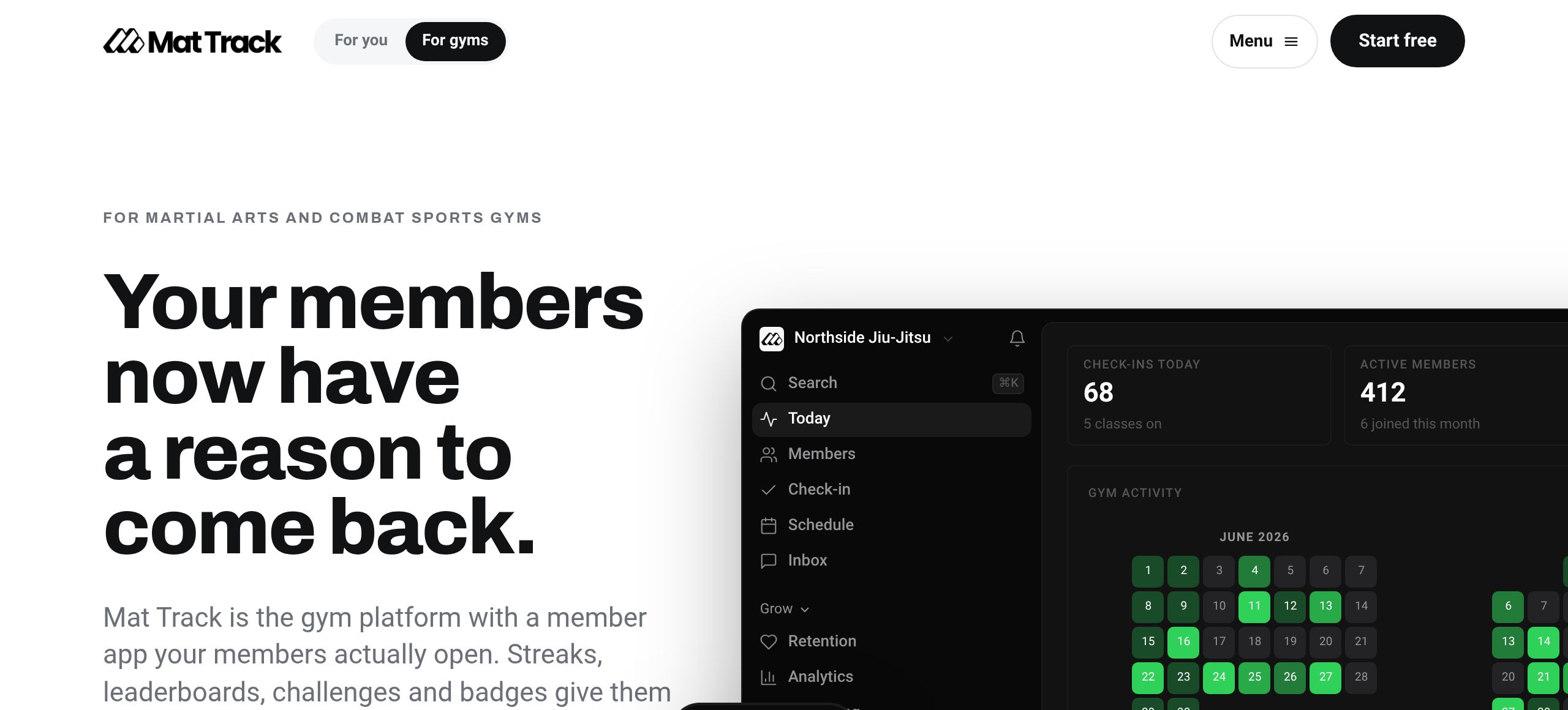
Ours, weigh accordingly. Mat Track's bet is that the most expensive event in any school is invisible: the student who stops coming without telling anyone. Every member is watched against their own 60-day attendance pattern, drops get flagged while a message still changes the outcome, and comeback challenges attach a target to the return. Ranks run across multiple arts, BJJ and Muay Thai on one profile, with grading criteria in the member app, and the app is built for daily habit, streaks, badges, leaderboards, community. Pricing is public: $49 Starter, $99 Growth (where retention alerts start), $199 Pro, billed monthly, a 7-day free trial, no platform transaction fees, as of October 2026. Best fit: any school whose real leak is quiet quitting, in any discipline.
Where it wins:
- The only platform here whose centre is noticing fading students automatically.
- Multi-art ranks with criteria students read in the app.
- From $49 a month after a 7-day free trial, and every price public.
Where it falls short:
- Belt-testing event administration is younger than Kicksite's or Zen Planner's.
- No website builder and no point of sale.
- Self-serve setup, with no account rep doing it alongside you.
Spark Membership, for enrolment-driven schools
The fourth most-detected platform in our crawl and the leader among karate and taekwondo schools, built for the front door: funnels, landing pages, SMS and email campaigns, point of sale, rep-led setup. Its price is one flat $199 to $249 a month at any school size, as of October 2026, with text credits and card processing on top, and its Capterra base is thin at 4.6 across 9 reviews (August 2026). Best fit: schools whose mats have room and whose marketing is the honest bottleneck.

Where it wins:
- The strongest enrolment and marketing tools in this niche.
- Rep-led setup, someone builds it with you.
- A real install base, the leader among karate and taekwondo schools in our crawl.
Where it falls short:
- One flat fee at any size, so a small school pays the same $199 to $249 a month as a large one.
- Retention is tools you drive, not alerts that find you.
- A thin review base, 9 on Capterra, for a platform this established.
More in our Spark Membership alternatives guide, and what Spark costs in full, its add-ons and card processing included, is in our Spark Membership pricing post.
Kicksite, for traditional schools and testing day
Close to two decades of martial-arts-only history and the market's deepest grading administration: custom curricula, eligibility rules, one-click promotions, full rank histories, native family billing. Pricing is flat and published, $49 to $199 with every feature at every tier, 4.8 on Capterra across roughly 130 reviews, as of August 2026. Students use a mobile web portal rather than a native app. Best fit: belt-driven traditional schools where testing day is the operational centre.

Where it wins:
- The best belt-testing and grading administration in the market.
- Flat, published pricing with nothing gated by tier.
- Family accounts built for parent-paid schools.
Where it falls short:
- Students get a website to log into, not a real app on their phone.
- Nothing watches attendance for you; spotting a fading student is still your job.
- Light outside belt administration, no funnels, basic reporting.
Full treatment in our Kicksite alternatives guide.
Gymdesk, the all-rounder with a website included
The most-installed platform in the crawl, and the simplest bill: $75 to $200 a month by member count, everything at every tier, website builder included, month to month, 30-day free trial advertised, 4.8 on Capterra across about 150 reviews, as of August 2026. Rank tracking is basic and the branded member app costs $100 extra. Best fit: schools that want one predictable price, a decent website and no drama, and can live with simple ranks.

Where it wins:
- The most-used platform among martial arts gyms, so help and peers are easy to find.
- One plain price with a website builder in the bundle.
- Month to month, with no exit fee.
Where it falls short:
- Belt and rank tracking is basic for a graded syllabus.
- The branded member app costs an extra $100 a month.
- You get reports to check, not alerts when a member is drifting.
Subject of our Gymdesk alternatives guide.
Zen Planner, for established multi-discipline schools
The second most-detected platform overall and the strongest in MMA, with the deepest feature set here: belt testing refined over two decades, a website product, the Engage marketing module. The price is a stack, $99 to $289 core plus $39 app, $99 website and $249 Engage, about $616 a month configured at 150 members, as of August 2026. Capterra 4.3 across 270 reviews, support praised, billing the recurring complaint, including reviewers reporting charges after cancelling. Best fit: established schools that will genuinely use the modules. The full table is in our Zen Planner pricing breakdown.

Where it wins:
- Belt testing as deep as anything in the market.
- The most complete feature set on this page, if you buy the modules.
- Two decades of martial arts pedigree and the №2 install base.
Where it falls short:
- The configured bill climbs fast, about $616 a month with the modules at 150 members.
- The price jumps each time your member count crosses a tier.
- Its own reviewers complain about billing, including charges after cancelling.
PushPress, for fitness-first gyms adding martial arts
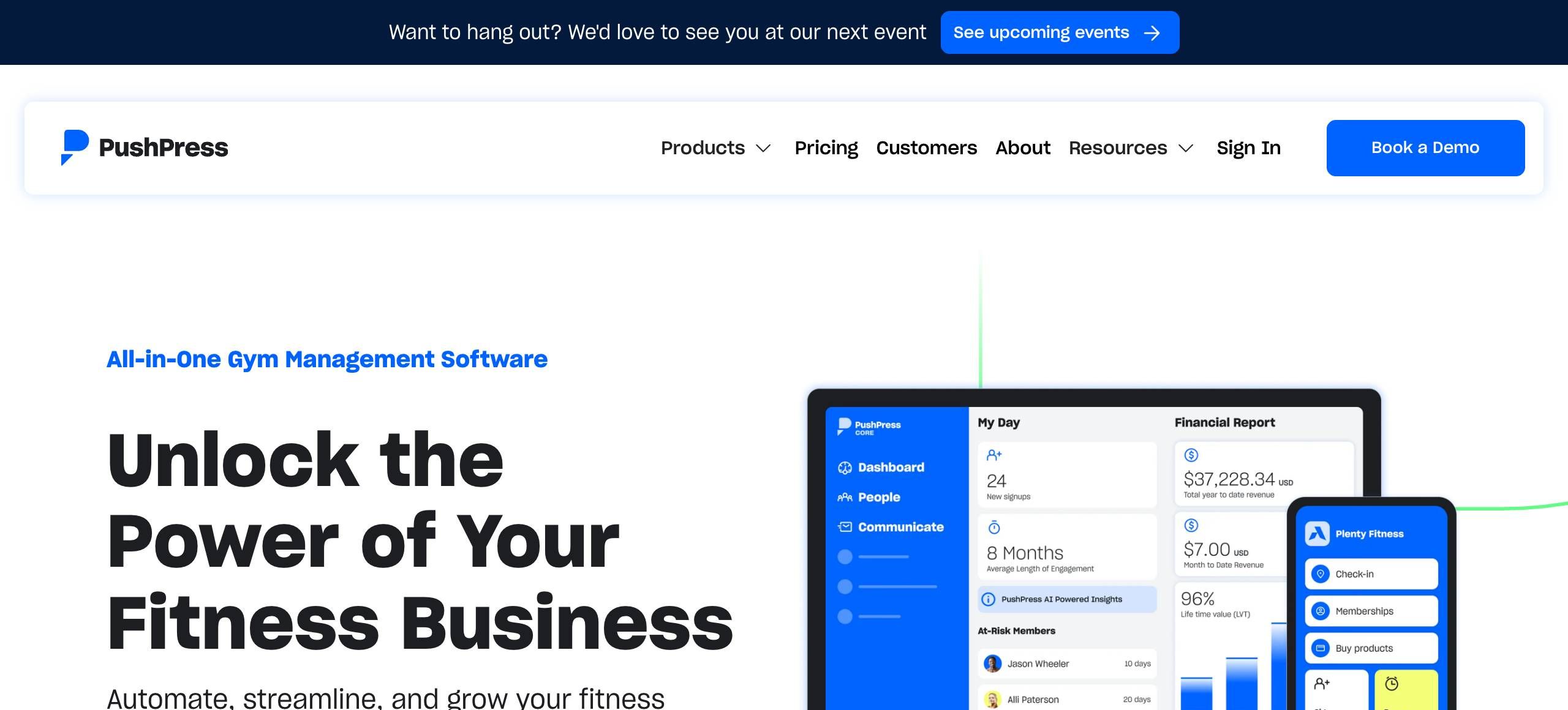
The transparent modern generalist: a $0 Free plan with unlimited members at 4.99% plus 30 cents on cards, then $159 Pro at 2.89% and $229 Max at 2.75%, with rank tracking in the paid tiers, 4.7 on Capterra across roughly 190 reviews, as of August 2026. It grew up in functional fitness, so a martial arts program lives in a well-built side room. Best fit: CrossFit-adjacent gyms adding a BJJ or striking program to an existing operation; the free-plan arithmetic is in our PushPress pricing breakdown.
Where it wins:
- Every price is public, down to the processing rates.
- A real free tier with unlimited members.
- Modern, well-supported software with plenty of integrations.
Where it falls short:
- The free plan's 4.99% card rate gets expensive as card volume grows.
- Belt and rank tracking needs the $159 Pro tier.
- Built for functional fitness first; martial arts is a side room, not the main hall.
Martialytics, for small schools that want it simple
Martial arts only and honestly priced: $69 to $199 a month with every feature at every tier, unlimited locations, a free student app, free leads and inactive students, standard Stripe rates with no revenue cut, belt tracking and family billing built in, as of August 2026. Capterra 4.7 across 21 reviews, support the highlight, mobile admin the wish. Best fit: small schools taking their first step off paper who want fair pricing and a human on the other end.

Where it wins:
- Simple published pricing and no revenue cut, ever.
- Belt tracking and family billing included at every tier.
- Support its own reviewers rave about.
Where it falls short:
- Nothing watches attendance for you; spotting a fading student is still your job.
- Reviewers wish for better mobile admin.
- A small team and a small review base, weigh it as you would any young vendor.
More on our Martialytics alternatives guide.
How to choose martial arts software
Start from your mat and your leak. Read the discipline guide that matches your school first, the leaders genuinely differ, then name the leak: if students join fine and fade between belts, buy retention, that is Mat Track's case and the mechanism is in our gym member retention guide; if testing day is the grind, buy grading administration, Kicksite or Zen Planner; if the mats have room, buy enrolment, Spark; if you just want the admin handled cheaply and predictably, Gymdesk and Martialytics are the safe simple picks. Six of the seven publish their prices, ours included at mattrackapp.com/gyms, so build your shortlist with a calculator and book any demo last. Our guide to what martial arts gym software costs does the sums, card fees included, at three school sizes. The one-to-one switching cases live on our compare hub.